


What German Retailers Get Wrong About ERP — And How SAP Business One Fixes It
Running a retail business in Germany in 2026 is not the same as it was five years ago. The customer who walks into your shop on a Saturday afternoon has probably already checked your stock levels online, compared your prices with two competitors, and read three reviews before they arrived. If your inventory system, your website, and your till are talking to each other, that customer experience can be seamless. If they are not, the cracks show very quickly — a product shown as in stock online that is not on the shelf, a return that the staff cannot process because the data is in a different system, a price that does not match between the shop floor and the webshop.
This is the gap that ERP software exists to close. And specifically, it is the gap that SAP Business One was built to close for businesses of exactly the size that most German retailers sit at: too large and complex for a basic accounting package, but not yet at the scale where a full SAP S/4HANA implementation makes commercial sense.
Yet many retail businesses are still running on a patchwork of disconnected tools — an accounting system here, a webshop platform there, a spreadsheet for stock somewhere in between — and wondering why operational costs keep climbing while visibility keeps shrinking.
The real cost of disconnected retail systems
The direct costs of software subscriptions are easy to see on a budget. The indirect costs are not. When your stock data lives in one place and your sales data lives in another, someone is manually reconciling them. Usually more than one person, more than once a week. That is payroll cost that adds no value to the customer. Overselling is another bill that arrives quietly. A stock figure that has not updated since the last manual sync is a liability. One customer ordering something that is physically out of stock generates a support ticket, a refund, and sometimes a review. Do it twenty times a month across a busy webshop and it becomes a measurable drag on your customer retention rate. Then there is the compliance cost. German retailers are operating under some of the most specific financial record-keeping requirements in the EU. The GoBD — the principles governing the proper management of digital business records — apply to every VAT-registered business in Germany. The ELSTER interface for electronic VAT submission, DATEV compatibility for your external accountant, and SEPA payment formats for your outgoing transactions are not optional extras. They are how retail finance works in Germany. A system that does not support them natively forces you to build workarounds, and workarounds cost time and create error. Most German retailers know they need better systems. The question is not whether to consolidate — it is which platform to consolidate on, and which partner to trust with the implementation.What SAP Business One actually does for a retail business
SAP Business One is a complete ERP system, which means it is a single platform that manages financial accounting, purchasing, stock, sales, CRM, and reporting in one place. For a retailer, the practical implications of that are significant. Stock levels update in real time across every sales channel. When a customer buys a jacket in the Berlin Mitte shop, that transaction reduces the available count in the webshop immediately. When a purchase order is raised with a supplier, the expected stock arrival is visible to the sales team before the goods arrive. There is no nightly synchronisation batch. There is no manual update. The data is current because it is the same data. For fashion and clothing retailers specifically, the variant management in SAP Business One handles what most basic stock systems struggle with. A single item that comes in four sizes and six colours is one product master in SAP Business One, with each size-colour combination tracked as a distinct variant. Reorder levels can be set at the variant level. Slow-moving variants can be identified without building a custom report. A product that sells well in size S but is overstocked in size XL is visible in a standard inventory query. The CRM module tracks the customer behind the purchase, not just the transaction. Purchase history, communication preferences, outstanding balances, loyalty notes — all attached to the business partner record. For retailers building repeat customer relationships rather than just processing one-time transactions, this turns the ERP from a back-office tool into something that the sales team actually uses.Omnichannel retail in Germany: where SAP Business One earns its place
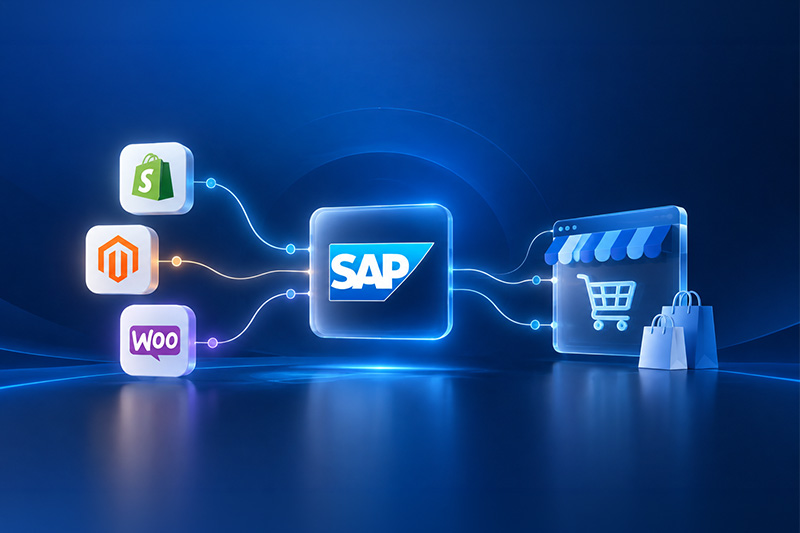
The German retail market has moved firmly toward omnichannel, and the operational pressure that creates is significant for mid-sized businesses. You are expected to offer consistent pricing across the shop floor and the webshop. You are expected to process click-and-collect orders in the same workflow as in-store purchases. You are expected to handle returns from online orders at the physical counter. Each of those expectations requires your systems to speak to each other cleanly. SAP Business One integrates natively with Magento, Shopify, Shopify Plus, and WooCommerce — the platforms that power the majority of German retail webshops at the SME level. When the integration is configured correctly, product data flows from SAP Business One into the webshop, and orders flow back. Stock levels sync in real time. Customer records created in the webshop appear in SAP Business One. Invoices generated in SAP Business One can be triggered automatically by webshop order completion. This is not a theoretical integration. It is what a correctly implemented SAP Business One setup delivers for a retailer with a live online shop. The configuration work involved in getting there is real and requires expertise — but once it is done, the operational overhead of managing two separate data environments disappears. POS integration is the other side of the omnichannel equation. SAP Business One supports point-of-sale integration, which means that till data feeds into the central stock and financial records without a separate upload or reconciliation step. For a retailer with multiple shop locations, this is how you get a single, live view of stock across all sites without a member of staff manually counting and reporting from each location.German compliance built in, not bolted on
This is the part of the SAP Business One conversation that matters most to a German retailer and gets covered least in general ERP guides. DATEV export is configured as standard in SAP Business One, which means your monthly financial data can be passed to your tax advisor or accountant in the format they expect, without any export-and-reformat step. ELSTER, the German electronic tax filing system, is integrated for VAT advance return submission. SEPA payment processing — including the generation of properly formatted payment files for your bank — is handled within the system. Multi-currency support handles EU trade without requiring a separate foreign exchange module. GoBD compliance is structural in SAP Business One. The audit trail, document archiving principles, and immutability of posted financial records are built into how the system works, not added through a third-party plugin. For a retailer that has had a VAT audit or is aware that one is possible, this is not a minor feature. It is the difference between a clean audit and a document management crisis. Intrastat reporting, relevant for retailers trading across EU member states, is also available in the system. For fashion retailers sourcing from European manufacturers and selling across Germany and neighbouring countries, this removes a reporting obligation that would otherwise require manual work.SAP Business One vs disconnected retail tools: the honest comparison
| Function | Spreadsheets + separate tools | SAP Business One |
| Real-time stock across channels | Manual sync, lag, errors | Live, automatic, single source |
| Webshop integration | Third-party connector or manual export | Native Magento, Shopify, WooCommerce |
| DATEV / ELSTER | Manual export and reformatting | Built-in, no extra steps |
| GoBD compliance | Depends on individual tools | Structural, audit-ready |
| Variant management (size/colour) | Separate SKUs, no parent-child link | Native variant tracking |
| POS integration | Separate system, manual reconciliation | Integrated in real time |
| Multi-location stock visibility | Reports from each site, manually compiled | Single live view |
| Customer CRM | Separate CRM or not done at all | Integrated, linked to transactions |







 Applicable for Package
 Optional