

SAP Business One Cloud: What Competitors Are Not Telling You
A straight-talking guide to the cloud ERP that small and mid-sized businesses in Germany and beyond are quietly switching to
There is a conversation happening in a lot of small and mid-sized businesses right now. It usually starts with someone in finance looking at a spreadsheet that has become too complicated. Or an operations manager who has spent the morning chasing stock figures from three different systems. Or a founder who realises that the business has grown just enough to make the current setup genuinely unworkable.
The conversation is about getting an ERP. And almost always, one of the first names that comes up is SAP.
Then someone googles the price and the conversation stalls.
This is the misunderstanding that has kept genuinely capable small businesses from investing in the right technology for years. SAP is not just for large enterprises. SAP Business One Cloud, delivered by a certified partner like Ingold Solutions GmbH, is specifically built for businesses with as few as two users and is available from €45 per user per month, including hosting on Microsoft Azure.
That is not a stripped-back version. It is the real thing.
This article covers what SAP Business One Cloud actually is, what competitors in this space are consistently failing to address, and why the Ingold Solutions approach to delivering it makes a genuine difference to the businesses that work with them.
What is SAP Business One Cloud?
SAP Business One is SAP’s dedicated ERP platform for small and mid-sized businesses. It is not a scaled-down version of SAP S/4HANA. It is its own product, purpose-built for companies that need proper business management software without the complexity and cost that comes with enterprise-grade systems. The cloud version simply means that instead of running SAP Business One on your own servers, it is hosted and managed in a professional data centre. You access it via a browser or the SAP Business One web client. Nothing needs to be installed locally. No one in your company needs to manage server infrastructure. Today, according to SAP’s own published figures, 68 per cent of small businesses and 87 per cent of mid-sized companies already rely on SAP cloud solutions. Those numbers tell a clear story: cloud-hosted ERP has moved from being a forward-looking choice to being the straightforwardly sensible one. SAP Business One Cloud covers the full range of business operations: finance and accounting, purchasing and procurement, inventory management, sales and order processing, customer relationship management, reporting and analytics, and distribution. Data is entered once and flows across every area of the business in real time. That single source of truth is what makes the system so different from running separate tools for each function.What Competitors Are Getting Wrong
The cloud ERP market for small and mid-sized businesses is genuinely competitive. Microsoft Dynamics 365 Business Central, Oracle NetSuite, Acumatica, and Odoo are all regularly positioned as alternatives to SAP Business One Cloud. Each of them has genuine strengths. But there are several things that most of them, and most SAP partner blogs, consistently fail to address.They hide the true cost
This is the most consistent failure across the market. A competitor publishes a headline price per user per month and implies that is what you will pay. It rarely is. Oracle NetSuite, for example, is cited by partners at implementation costs of between £25,000 and £150,000 before you get to the monthly subscription. Microsoft Dynamics 365 Business Central starts at €70 per user per month for the Essentials tier but does not include hosting, and the total cost of a Business Central implementation through a partner frequently exceeds €20,000 for a business of any meaningful size. Odoo is often presented as the budget option, but the open-source Community edition lacks the features most real businesses need, and the Enterprise version, combined with implementation, support, and customisation costs, rarely ends up being the bargain it appears. With Ingold Solutions, the all-inclusive cloud package for SAP Business One starts at €45 per user per month for 12 months. That price includes the licence and Microsoft Azure hosting. There is a defined minimum contract period of one year, and the cancellation notice period is three months from month end. There are no surprise infrastructure charges.They make implementation sound simple
Most ERP providers will tell you implementation is straightforward. Very few will tell you honestly how long it takes. NetSuite implementations are typically cited by their own partners at four to nine months. Business Central projects of any meaningful complexity commonly run to three to six months and beyond. Ingold Solutions delivers SAP Business One Cloud with a rapid deployment option that has businesses live within 24 hours for the starter configuration. For businesses that need more depth, the implementation programme is structured and defined, with clear packages ranging from a basic configuration at €400 to a full professional implementation at €3,900. Every stage of what is included is documented. There are no vague project scopes that grow unexpectedly.They do not talk about what happens after go-live
Getting an ERP live is one thing. Running it is another. Most competitor content focuses almost entirely on features and pricing. Very little of it talks about what the support relationship looks like once the system is operational. Ingold Solutions’ all-inclusive package includes direct access to the Ingold support hotline, regular software updates and patches handled by the team, security management, firewall, anti-malware, and regular data backups. All of that is part of the package, not an additional service tier.They do not combine ERP with e-commerce
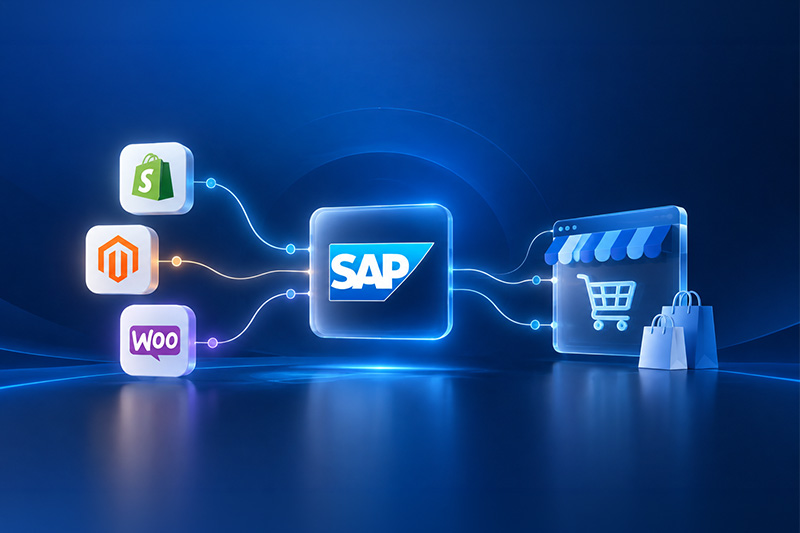
This is perhaps the most significant gap in what competitors offer. For small and mid-sized businesses that sell online, the ERP and the online store need to work together. Most ERP providers treat that integration as a third-party problem. Ingold Solutions is both a certified SAP partner and an established e-commerce agency with in-house-built connectors for Magento, Shopify, Shopware, and WooCommerce. The SAP Business One and Magento integration, for example, is a native connector developed by the Ingold team, running without middleware, and synchronising orders, inventory, pricing, and customer data in real time. That combination of ERP and e-commerce expertise under one roof is not something most SAP partners can offer.Who SAP Business One Cloud Is Actually Built For
There is a persistent myth that SAP is only relevant once a business reaches a certain scale. It is not true, and the SAP Business One Cloud pricing structure from Ingold Solutions puts that to rest fairly quickly. The Starter Package is specifically designed for businesses with up to five users. It provides access to the core features needed for service and distribution operations, including mobile app rights and indirect access for connected systems. At €45 per user per month including Azure hosting, it represents an entry point that is competitive with, or cheaper than, most of the alternatives that are marketed as budget-friendly. For businesses beyond that early stage, the Limited User licence at €55 per user per month provides role-based access across CRM, Finance, or Logistics. And for businesses that need full, unrestricted access to every module, the Professional User licence at €105 per user per month covers everything, with no restrictions. SAP Business One Cloud also suits subsidiaries of larger enterprises particularly well. A parent company running SAP S/4HANA or another enterprise ERP can use SAP Business One Cloud for subsidiary operations, keeping those entities integrated with the wider group while maintaining local flexibility. The system runs in a browser and is globally accessible. Startups are another strong fit. For a young company that does not want to outgrow its ERP in three years, starting on SAP Business One Cloud means starting on a platform that scales with the business rather than one that needs replacing as it grows.What SAP Business One Cloud Actually Covers
One of the frustrations with the way SAP Business One is often discussed online is that the module coverage is treated as a list rather than explained in terms of what it actually means for a business running it day to day. Here is what each functional area delivers in practice.- Finance and accounting: The general ledger, accounts payable, accounts receivable, cost accounting, budgeting, multi-currency support, and financial reporting are all managed in one place. For businesses in Germany, the system includes predefined chart of accounts structures (SKR03 and SKR04), ELSTER integration for VAT filings, DATEV configuration and export, and XRechnung support for electronic invoicing. None of that needs a separate tool.
- Purchasing and procurement: Purchase orders, goods receipts, landed costs, freight costs, and vendor management are handled within the same system that manages inventory and finance. When a purchase order is raised, it immediately affects stock projections. When a goods receipt is confirmed, it flows into the accounts without a manual journal.
- Inventory management: Real-time stock levels, batch and serial number tracking, warehouse bin management, and inventory cycle counting are all available. For businesses managing multiple warehouses or complex stock movements, this removes the need for a separate warehouse management tool.
- Sales and CRM: From the initial sales enquiry through quotation, order, delivery, and invoice, the entire sales cycle is managed in one system. CRM functionality covers contact management, activity tracking, and opportunity management. Sales data feeds directly into financial reporting without reconciliation between systems.
- Reporting and analytics: Interactive dashboards and customisable KPI displays give management a real-time view of the business. Reports are generated from live data, which means they reflect the current state of the business rather than a snapshot from the previous night’s data export.
- Distribution: Delivery scheduling, picking, and logistics management are integrated with inventory and sales, so the business always knows what is committed, what is available, and what needs to be replenished.







 Applicable for Package
 Optional