Most small and medium-sized businesses reach the same point eventually. The spreadsheets start breaking. The accounting software can’t talk to the inventory system. Someone emails a version of a report that’s already out of date. The business hasn’t failed — it’s grown. But the infrastructure hasn’t kept up, and the gap is starting to cost real money.
SAP Business One Cloud is the solution that closes that gap for companies between 10 and 250 employees — the size bracket where generic accounting tools fall short but full enterprise ERP is overkill. It integrates finance, inventory, purchasing, sales, CRM, and reporting into a single system, runs on Microsoft Azure’s infrastructure, and is accessible from anywhere with an internet connection. No local servers. No IT team required to maintain it. No nine-month implementation that disrupts the business.
The numbers behind SAP Business One’s adoption tell their own story. Over 83,000 companies in more than 170 countries run their business on SAP Business One, making it the world’s most widely deployed ERP for SMEs. Cloud-based SAP Business One deployments have grown by 63% globally in recent years, and the SME ERP market as a whole is growing at 11–12% per year. That’s not trend-chasing. That’s a market reaching a maturity point where cloud ERP is no longer a premium option — it’s the practical one.
| 83,000+
companies run SAP Business One globally
SAP, December 2025 |
|
63%
growth in SAP B1 cloud deployments
Business Research Insights |
|
11–12%
annual SME ERP market growth rate
Carlsquare, Q1 2026 |
|
99.9%
uptime guaranteed via Microsoft Azure
Azure SLA commitment |
Why SAP Business One Cloud Outperforms On-Premise for Most SMEs
This used to be a more nuanced question. Five years ago, there were genuine arguments for running SAP Business One on a local server: more control, lower monthly costs for larger teams, no dependency on internet connectivity. Those arguments haven’t disappeared entirely, but the balance has shifted considerably.
The operational cost of maintaining on-premise infrastructure is the most significant factor. Local server deployments require upfront hardware investment plus ongoing maintenance, software updates that must be manually applied, internal IT resources to manage security patches, and backup procedures that are only as reliable as whoever is running them. For a 15-person distribution company in Hamburg or a 30-person wholesale operation in Munich, this represents a cost and a risk that the cloud model eliminates.
The other shift is the workforce. German enterprises are increasingly favouring scalable, subscription-based cloud software for cost efficiency, agility, and rapid deployment, according to the 2025 ISG Provider Lens SAP Ecosystem report. Remote access has moved from a nice-to-have to an operational requirement. A cloud-hosted ERP that works from any browser, on any device, from any location, isn’t a future-proofing exercise — it’s today’s standard.
| |
SAP Business One Cloud |
On-Premise Installation |
| Infrastructure |
Hosted on Microsoft Azure — no hardware required |
Company-owned servers, hardware upgrades required |
| Upfront cost |
Low — subscription from €45/user/month incl. hosting |
High — one-time licence from €1,140 + hardware + maintenance |
| IT maintenance |
Managed by Ingold Solutions — zero internal burden |
Requires internal IT team or outsourced support |
| Access |
Any browser, any device, any location |
Office network or VPN required |
| Updates |
Automatic — always on latest SAP version |
Manual updates — risk of version lag |
| Scalability |
Add or remove users instantly |
Requires hardware and licence changes |
| Data backup |
Daily automated backups with disaster recovery |
Manual backup schedule, risk of gaps |
| GDPR |
Azure EU data centres — fully GDPR/DSGVO compliant |
Company responsible for all compliance |
What SAP Business One Cloud Actually Does: A Module-by-Module Overview
One of the most common misconceptions about SAP Business One is that it’s complex to use day-to-day. It isn’t. The system is purpose-built for SMEs, not adapted from an enterprise platform. Each module addresses a specific operational problem, and they all share a single database — so when a sales order is created, inventory updates automatically, the finance module reflects it, and the warehouse team sees it without anyone manually entering data twice.
Finance and accounting
The accounting module handles the full range of financial management: journal entries, accounts payable and receivable, bank reconciliation, cost centre management, fixed assets, and multi-currency transactions. For German businesses, GoBD-compliant bookkeeping is built in, along with DATEV export, ELSTER configuration, and the VAT ID validation that German tax compliance requires. These aren’t add-ons — they’re standard.
Inventory and warehouse management
Real-time inventory tracking across multiple warehouses, serial and batch number management, goods receipts and issue processing, and automated reorder point management. For wholesale and distribution businesses, this is typically where the ROI is clearest: stock discrepancies fall, order fulfilment improves, and the hours spent manually reconciling inventory reports disappear.
Sales and CRM
From quotation to sales order to delivery note to invoice — the entire sales process runs within a single workflow. Customer data, pricing tiers, contact history, and activity logs are all centralised. The CRM functionality covers opportunity management, contact management, and service call tracking. For businesses managing a sales team across multiple regions, this replaces a patchwork of spreadsheets and disconnected tools with a single view.
Purchasing and supply chain
Purchase orders, goods receipts, supplier invoice management, and landed cost calculations. The supply chain module provides full visibility from purchase order to final goods receipt, with multi-currency support and exchange rate integration. Transfer pricing documentation — relevant for businesses with cross-border operations — is supported natively.
Reporting and business intelligence
Customisable dashboards, drag-and-drop report builder, and direct Excel integration with live data links. Management gets a real-time view of business performance without waiting for month-end reports. The system also includes a natural language query function — ask the system to generate last month’s sales report and it returns the data in seconds.
Ecommerce integration
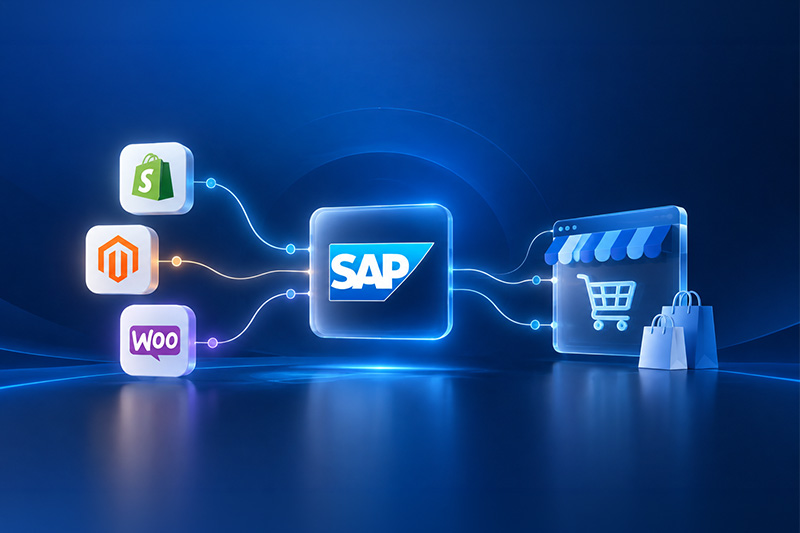
SAP Business One Cloud integrates directly with Magento, Shopify, and WooCommerce — meaning online orders flow automatically into the ERP, inventory updates in real time, and fulfilment triggers without manual intervention. Integration with ecommerce platforms has accelerated by over 48% in the past three years as businesses increasingly run both physical and digital sales channels from a single system.
Microsoft Azure Hosting: What It Means for Security, GDPR, and Performance
The infrastructure question matters more in Germany than in most other European markets. Strict data protection laws make many German companies hesitant to store data in the cloud — a concern that is entirely legitimate and one that the Azure hosting model directly addresses.
Ingold Solutions hosts SAP Business One on SAP-certified Microsoft Azure HANA servers, with data stored in certified EU data centres. This means all data remains within EU jurisdiction, subject to EU data protection law, and compliant with GDPR (DSGVO) requirements from day one. The infrastructure is not a general-purpose cloud environment — it is specifically configured for SAP Business One, with the performance tuning, monitoring, and security layers that the system requires.
Security architecture: what’s in place by default
✔ TLS encryption: All data in transit is encrypted using modern TLS protocols
✔ SSL certificates: Secure connections between all devices and the cloud environment
✔ Two-factor authentication: Optional MFA available for all user accounts
✔ Daily automated backups: Full backup with disaster recovery — point-in-time restore available
✔ Regular security monitoring: Administrator team monitors for threats and anomalies continuously
✔ EU data residency: All data stored in certified EU Azure data centres — GDPR compliant
✔ 99.9% uptime SLA: Redundant systems guarantee availability without dependency on your own hardware
SAP Business One Cloud Pricing: What You Actually Pay
Pricing transparency is one of the most common complaints about ERP vendors. With SAP Business One Cloud through Ingold Solutions, the cost structure is straightforward and built around three user types, each available under two plans.
Under Plan A (Monthly Subscription), the cloud licence includes Azure hosting fees. Starter Package users start from €45/month per user (first 12 months), Professional Users from €105/month. Under Plan B (One-Time Perpetual Licence), a Starter Package user is €1,140 with annual maintenance at 19% of contract value. Professional users are €2,700. For most growing SMEs, Plan A is the operationally sensible choice: predictable monthly costs, no capital expenditure, and the freedom to scale users without renegotiating a licence agreement.
Implementation packages start at €500 (Basic) and run to €4,900 (Professional), covering everything from initial company database setup and SAP module configuration through to master data import, DATEV integration, ELSTER configuration, and staff training. The right package depends on the complexity of your existing data and processes — something Ingold Solutions assesses during the free consultation before any commitment is required.
included What’s in cloud hosting that on-premise doesn’t cover
- SAP-certified Microsoft Azure HANA server infrastructure
- Universal and Virtual Printer — print from cloud to any local printer, no driver issues
- SAP Business One Web Client — browser access with no local installation required
- Flexible access: HTML5 browser, Remote Desktop, or Published Applications
- Centralised licence and resource management by Ingold’s admin team
- Always on the latest SAP Business One version — automatic updates
- Daily backup with disaster recovery included as standard
Why Work with Ingold Solutions as Your SAP Partner
SAP Business One is available through a global network of certified partners. The implementation quality, ongoing support, and technical depth vary significantly between them — and for a business running its entire operation through a single ERP system, that variation matters.
Ingold Solutions is a Berlin-based SAP Silver Partner with implementation experience across 11 industry verticals, including wholesale, manufacturing, logistics, pharma, chemicals, retail, and food. The team covers both ERP implementation and cloud infrastructure — which means the same partner that configures your SAP Business One instance also manages the Azure hosting environment it runs on. There is no technical handoff between an ERP consultant and a separate hosting provider. One team, one point of contact, one SLA.
For businesses with cross-border operations — particularly those expanding into Germany or operating across India and Germany — Ingold Solutions holds dual SAP Silver Partner status in both markets. SAP Business One can be implemented as a single coherent system across both entities, with local compliance configurations for each jurisdiction handled within the same deployment.
Ingold Solutions at a glance
SAP Silver Partner: Certified in Germany and India
Microsoft Solutions Partner: Azure hosting and Microsoft 365 integration
ISO 9001 certified: Quality-controlled implementation and support processes
Industries served: 11 verticals including wholesale, manufacturing, logistics, pharma, retail, food, chemicals
Cloud infrastructure: SAP Business One hosted on Azure HANA — managed end to end
Ecommerce integration: Magento, Shopify, and WooCommerce connectors available
Location: Berlin — serving the German and European mid-market
FREQUENTLY ASKED QUESTIONS
SAP Business One Cloud: Your Questions Answered
What is SAP Business One Cloud and how does it differ from the on-premise version?
SAP Business One Cloud is the subscription-based, cloud-hosted version of SAP’s ERP platform for SMEs. Instead of installing the software on your own servers, the system is hosted on certified Microsoft Azure infrastructure and accessed via browser or remote desktop. The core functionality is identical to the on-premise version — finance, inventory, sales, CRM, purchasing, and reporting — but without the hardware investment, manual update cycles, or internal IT overhead. Updates are applied automatically, backups run daily, and access is available from any device with an internet connection.
How much does SAP Business One Cloud cost per month?
Through Ingold Solutions, SAP Business One Cloud is available from €45 per user per month for the first 12 months (Starter Package, including Azure hosting fees), rising to €55/month thereafter. Limited Users are from €55/month, and Professional Users — with access to all modules — from €105/month for the first 12 months. Implementation packages start at €500 for the Basic entry level and run to €4,900 for the Professional package, which includes master data import, DATEV integration, ELSTER configuration, and full staff training. A free trial is available with no credit card required.
Is SAP Business One Cloud GDPR compliant for German businesses?
Yes. Ingold Solutions hosts SAP Business One on SAP-certified Microsoft Azure HANA servers with data stored exclusively in certified EU data centres. This means all data remains within EU jurisdiction and subject to GDPR (DSGVO) from day one. The system also includes GoBD-compliant bookkeeping as standard — the German requirement for digital accounting records. German companies moving to cloud SAP specifically cite EU data residency as the critical requirement, and Azure’s EU hosting model addresses this directly.
How long does it take to implement SAP Business One Cloud?
Implementation timelines depend on company size, existing data complexity, and which modules are being deployed. For a standard SME deployment, go-live is typically achievable within 4 to 12 weeks. The Basic implementation package — suited to businesses with straightforward requirements — can be significantly faster. Ingold Solutions conducts an initial consultation before any package is selected, which defines the scope, timeline, and which implementation package fits the business. A free trial is available to allow teams to explore the system before committing.
Can SAP Business One Cloud integrate with our ecommerce platform?
Yes. SAP Business One Cloud integrates natively with Magento, Shopify, and WooCommerce. Online orders flow automatically into the ERP, inventory updates in real time across both the ecommerce storefront and the warehouse system, and invoicing and fulfilment are triggered without manual data entry. Ecommerce integration with SAP Business One has accelerated by over 48% in recent years as more businesses run combined physical and digital sales operations from a single ERP.
What happens to our data if we stop the subscription?
Your data remains yours. Ingold Solutions provides full data export in standard formats prior to any contract termination. The GDPR obligation to provide data portability applies, and the process for data extraction is covered in the service agreement before any subscription starts. This is a standard question and one Ingold Solutions addresses explicitly in the initial consultation, so there are no surprises.
Do we need an internal IT team to run SAP Business One Cloud?
No. That’s one of the principal reasons the cloud model suits SMEs. Ingold Solutions manages the Azure infrastructure, handles SAP Business One updates, monitors security, manages user access rights, and provides technical support. Your team accesses the system via browser or remote desktop and uses it as a business tool — without needing to understand or manage what runs underneath it. For businesses without a dedicated IT function, this is typically the most significant operational advantage of the cloud deployment model.
Can SAP Business One Cloud handle multiple companies or international operations?
Yes. SAP Business One Cloud supports multi-company and multi-currency setups within a single instance. For businesses operating across Germany and another country — particularly those expanding from India into Germany or vice versa — Ingold Solutions can configure a unified SAP Business One deployment with separate legal entity management, country-specific compliance settings, inter-company transaction handling, and consolidated reporting. This is a core strength of Ingold’s dual SAP Silver Partner status in Germany and India.
The Bottom Line: Cloud ERP Is Now the Practical Choice for SMEs
The ERP market has moved. Cloud ERP now accounts for 70% of all ERP deployments globally and grows at 14.5% annually compared to on-premise’s 2%. For SMEs specifically, the global ERP software market is projected to reach $199.59 billion by 2030, driven primarily by cloud adoption among mid-sized businesses that have outgrown generic accounting tools and need the operational infrastructure that larger competitors already have.
SAP Business One Cloud on Microsoft Azure, implemented and managed by Ingold Solutions, gives SMEs that infrastructure: a single system for finance, inventory, sales, purchasing, CRM, and reporting, running on enterprise-grade cloud infrastructure, with all the GDPR compliance, security architecture, and local support that operating in Germany requires.
The free trial requires no credit card and no commitment. The free consultation identifies whether the system is right for your business before any implementation package is selected. Both are good places to start.
Try SAP Business One Cloud — free, no credit card required.
Book a free demo or start a free trial with Ingold Solutions, certified SAP Silver Partner in Germany.
https://ingoldsolutions.com/en









 Applicable for Package
 Optional