


SAP Business One Road Map 2026: What Growing Businesses Should Be Paying Attention To
Every January, technology vendors publish their predictions.
Every February, analysts publish theirs.
And by March, most business owners are left wondering what any of it actually means for their company.
The SAP Business One Road Map 2026 is no different.
You can read dozens of summaries discussing cloud, AI, automation, analytics, and digital transformation. Most are technically correct. Few answer the question that matters:
What should a growing business actually do with this information?
At Ingold Solutions, we spend our time helping manufacturers, wholesalers, distributors, e-commerce companies, and service businesses implement SAP Business One. What we've noticed recently is that the conversation has changed. Five years ago, businesses wanted to know what SAP Business One could do. Today, they want to know whether it can support where they're going. That's a very different discussion.The Most Important Thing in SAP's 2026 Road Map Isn't a Feature
Most ERP roadmap articles start by listing new capabilities. Let's start somewhere else. The most significant message in SAP's 2026 direction is that SAP Business One remains an actively supported and strategically important ERP platform. That may sound obvious. It isn't. One of the biggest concerns we hear from companies evaluating ERP systems is whether they'll be forced into another migration in a few years. No business wants to invest time, money, and resources implementing an ERP system only to discover that the vendor's focus has moved elsewhere. The continued investment in SAP Business One should reassure businesses that are planning growth over the next five to ten years. The roadmap isn't simply about new features. It's about long-term confidence.Why More Companies Are Looking at SAP Business One Cloud
Something interesting happened during the last few years. The first question used to be: "Is cloud secure?" Now the question is:"Why are we still running servers?"
That shift says a lot about how business priorities have changed. Many small and midsize businesses discovered that maintaining infrastructure doesn't create competitive advantage. Selling products does. Serving customers does. Improving operations does. Managing servers generally does not. This explains why SAP Business One Cloud continues to gain momentum. The benefits are no longer theoretical. Businesses have experienced them firsthand:- Easier access for remote teams
- Lower infrastructure management requirements
- Predictable monthly costs
- Faster deployment
- Simpler scalability
The AI Conversation Is Missing the Point
No topic receives more attention than artificial intelligence. Yet most discussions about AI in ERP systems focus on the technology itself. Business leaders tend to think differently. During ERP evaluations, nobody says: "I need artificial intelligence." What they actually say is: "I need more accurate forecasts." "I need better visibility into inventory." "I need faster reporting." "I need to reduce manual work." That distinction matters. Technology is only valuable when it solves a business problem. The most useful AI capabilities won't be the flashy ones. They'll be the features that quietly help teams make better decisions. Imagine a purchasing manager being warned about a future stock shortage before it becomes a problem. Or a finance team identifying unusual payment behaviour before it affects cash flow. Those are the kinds of improvements that create measurable business value.Integration Is Becoming More Important Than ERP Features
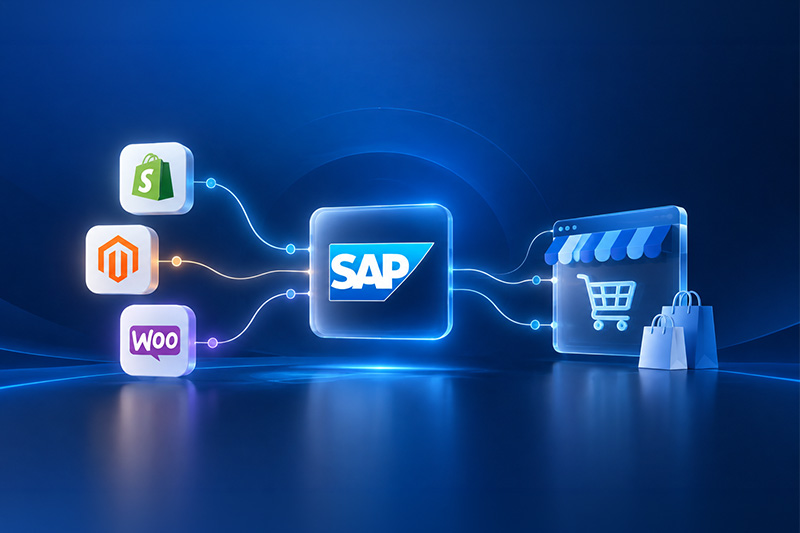
Here's a reality many growing businesses face. They already have enough software. The challenge isn't finding another application. The challenge is getting everything to work together. A typical company might use:- SAP Business One
- Microsoft 365
- Shopify
- Magento
- Banking platforms
- Shipping software
- Customer service systems
The Road Map Means Different Things for Different Industries
One mistake many articles make is treating all businesses the same. The reality is very different.Manufacturers
Manufacturers often focus on production functionality. However, many of the biggest gains come from improving visibility across purchasing, inventory, production, and finance. When departments share accurate information, planning becomes significantly easier.Wholesale and Distribution Businesses
Distributors increasingly need real-time inventory visibility. Customer expectations continue to rise, and delayed information can quickly become lost revenue. For these companies, reporting and inventory management remain critical priorities.E-Commerce Businesses
Online retailers face a different challenge. Growth often creates complexity faster than expected. Multiple sales channels, inventory synchronisation, customer management, returns processing, and financial reconciliation can quickly become overwhelming. For many e-commerce companies, the future of ERP is less about new features and more about stronger connectivity.Service-Based Businesses
Service organisations often prioritise project visibility, resource planning, profitability tracking, and financial reporting. As margins become tighter, access to reliable data becomes increasingly important.If We Were Advising a Growing Business Today
If a company approached us in 2026 and asked for guidance, our recommendation would be surprisingly simple. First, focus on business processes. ERP software amplifies existing processes. Good processes become more efficient. Poor processes become more visible. Second, avoid unnecessary customisation. Many businesses try to replicate every historical process inside a new ERP system. This often creates complexity without creating value. Third, prioritise reporting early. Companies frequently focus on transactions and workflows while overlooking management visibility. The ability to make faster decisions often generates more value than any individual automation. Finally, think long term. Choose technology that supports where the business intends to be, not where it happens to be today.What We Expect Beyond 2026
If current trends continue, several developments seem likely. Cloud adoption will continue increasing. Automation will become more intelligent. Integration requirements will grow. Business users will expect easier access to information. And data-driven decision-making will become increasingly important. Interestingly, none of these trends are really about technology. They're about helping businesses operate more effectively. The software simply enables that outcome.What the SAP Business One Road Map 2026 Is Really Telling Businesses
After all the discussions about cloud, AI, analytics, and integrations, the central message is surprisingly straightforward. SAP Business One continues to evolve. SAP continues to invest. And businesses that choose the platform today can do so with confidence that it remains an important part of SAP's long-term strategy. For growing organisations, that stability matters. Technology changes quickly. Business challenges do not. Companies still need visibility. They still need control. They still need reliable information to make good decisions. The SAP Business One Road Map 2026 suggests that SAP Business One will continue helping businesses achieve exactly that for many years to come.About Ingold Solutions
Ingold Solutions is a certified SAP Partner helping manufacturers, wholesalers, distributors, e-commerce companies, and service organisations implement, optimise, and scale SAP Business One solutions.From SAP Business One Cloud deployments and ERP migrations to e-commerce integrations and long-term support, Ingold Solutions helps businesses turn technology investments into measurable operational improvements.






 Applicable for Package
 Optional