

SAP Business One Cloud: Key Features, Benefits, and Why Growing Businesses Are Moving to the Cloud
Small and medium-sized businesses face a challenge that rarely appears in business plans but affects growth every day: disconnected systems.
Finance runs on one app. Sales keeps things going on spreadsheets or CRMs. The warehouse has its own inventory software, while procurement sorts everything out through endless email threads and more spreadsheets. As business picks up, information gets scattered, decisions take longer, and costs tend to go up.
According to research from IDC, organizations that modernize core business systems gain significantly greater operational visibility and decision-making speed compared to companies relying on disconnected applications. Meanwhile, Gartner continues to identify cloud ERP as one of the most important technology investments for organizations seeking scalability and business agility.
This is where SAP Business One Cloud has become a preferred solution for growing companies.
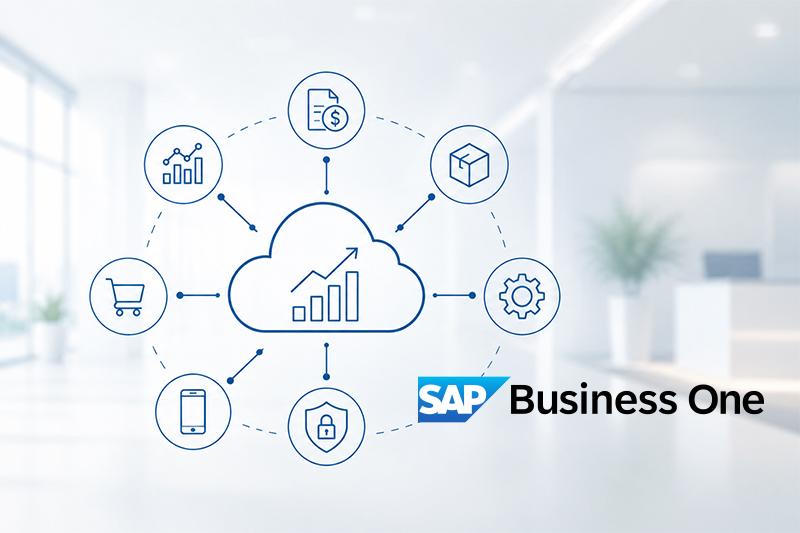
Rather than managing multiple disconnected systems, SAP Business One Cloud brings finance, inventory, purchasing, sales, customer management, production, reporting, and analytics into a single cloud-based platform. Businesses gain real-time visibility across departments while eliminating much of the manual work that slows growth.
Today, more than 83,000 companies worldwide use SAP Business One, making it one of the most widely adopted ERP solutions for small and midsize enterprises globally.
In this guide, we'll explore the key features of SAP Business One Cloud, compare them with competing ERP platforms, and explain why many organizations choose Ingold Solutions, a certified SAP Business One Partner, for implementation and support.
What Is SAP Business One Cloud?
SAP Business One Cloud is SAP's enterprise resource planning (ERP) solution designed specifically for small and medium-sized businesses. Unlike traditional on-premise ERP deployments that require extensive infrastructure investments, SAP Business One Cloud operates through secure cloud environments such as Microsoft Azure. This allows businesses to access their ERP system from anywhere while reducing infrastructure costs and simplifying maintenance. The platform centralizes:- Financial management
- Sales and CRM
- Purchasing
- Inventory management
- Production planning
- Business intelligence
- Reporting and analytics
Why Businesses Are Choosing Cloud ERP
The cloud ERP market continues to grow rapidly. According to Gartner research, cloud ERP adoption is accelerating because organizations require:- Faster deployment
- Lower infrastructure costs
- Improved scalability
- Better remote accessibility
- Enhanced cybersecurity
- Continuous software updates
Key Features of SAP Business One Cloud
-
Comprehensive Financial Management
- General ledger
- Accounts payable
- Accounts receivable
- Banking operations
- Financial reporting
- Budget management
- Cash flow tracking
- Tax management
-
Real-Time Inventory and Warehouse Management
- Real-time inventory tracking
- Multi-warehouse management
- Batch tracking
- Serial number tracking
- Automated replenishment
- Inventory forecasting
- Goods receipt processing
-
Integrated Sales and Customer Relationship Management
- Lead management
- Opportunity tracking
- Customer account management
- Sales quotations
- Order processing
- Customer interaction history
- Pipeline forecasting
-
AI-Driven Workflows and Intelligent Decision Support
- Demand forecasting
- Inventory optimization
- Supplier analysis
- Customer behavior insights
- Financial anomaly detection
- Automated recommendations
- Inventory shortages can be predicted before they impact customers.
- Procurement teams can identify supplier risks earlier.
- Finance teams can detect unusual spending patterns automatically.
- Sales managers can forecast pipeline performance more accurately.
-
Embedded Analytics and Real-Time Dashboards
- Real-time dashboards
- Interactive reporting
- KPI monitoring
- Financial analysis
- Sales forecasting
- Operational performance tracking
-
Microsoft 365 and Productivity Integration
- Outlook
- Excel
- Teams
- Word
- OneDrive
- Synchronize contacts with Outlook
- Link appointments and tasks
- Export reports to Excel
- Access live ERP data within spreadsheets
- Improve collaboration between departments
SAP Business One Cloud vs Leading ERP Competitors
When evaluating ERP software, businesses frequently compare SAP Business One Cloud against other well-known platforms. Let's examine how it compares to the most commonly considered alternatives.SAP Business One Cloud vs Oracle NetSuite
Oracle NetSuite is one of the largest cloud ERP competitors in the market. NetSuite Strengths- Strong cloud-native architecture
- Enterprise scalability
- Global financial management
- Lower implementation complexity
- Faster deployment
- Lower total cost of ownership
- Stronger fit for SMEs
- Extensive manufacturing and distribution functionality
SAP Business One Cloud vs Microsoft Dynamics 365 Business Central
Business Central is another major competitor targeting growing businesses. Business Central Strengths- Tight Microsoft ecosystem integration
- Familiar user interface
- More mature manufacturing functionality
- Strong inventory management
- Established SME ERP ecosystem
- Proven global deployment history
SAP Business One Cloud vs Acumatica
Acumatica has gained popularity among mid-market organizations. Acumatica Strengths- Flexible licensing
- Modern user interface
- Larger global ecosystem
- SAP innovation roadmap
- Extensive partner network
- Proven international deployment capabilities
- Open-source architecture
- Large application marketplace
- Enterprise-grade governance
- Strong compliance capabilities
- Higher scalability
- More robust financial controls
- Greater implementation consistency
Why Businesses Choose Ingold Solutions as Their SAP Business One Partner
Choosing the right ERP platform is important. Choosing the right implementation partner is equally critical. Even the best ERP system can fail if implementation, integration, training, and support are not handled correctly. Ingold Solutions is a certified SAP Silver Partner with extensive experience delivering SAP Business One Cloud projects across multiple industries, including:- Manufacturing
- Wholesale distribution
- Retail
- Logistics
- Pharmaceuticals
- Food and beverage
- Chemicals
- Professional services
- SAP Business One implementation
- Microsoft Azure hosting
- ERP customization
- E-commerce integration
- Ongoing support
- User training
- Magento
- Shopify
- WooCommerce
- Third-party logistics providers
- CRM platforms
- Business intelligence tools
SAP Business One Cloud Pricing: What Should Businesses Expect?
One of the most common questions businesses ask is: "How much does SAP Business One Cloud cost?" The answer depends on several factors:- Number of users
- Licensing model
- Required modules
- Custom integrations
- Industry-specific requirements
- Hosting environment
- Duplicate data entry
- Inventory inaccuracies
- Manual reporting
- Procurement inefficiencies
- Lost sales opportunities
- Poor forecasting
Future Trends Shaping SAP Business One Cloud
The ERP landscape continues to evolve rapidly. Several trends are expected to influence how businesses use SAP Business One Cloud over the next five years. AI-First ERP Systems Artificial intelligence is moving from a competitive advantage to a standard business requirement. According to Gartner, generative AI and intelligent business applications are becoming central to ERP strategies worldwide. Future SAP Business One Cloud environments will increasingly support:- Predictive planning
- Autonomous workflows
- Intelligent recommendations
- Natural language reporting
- AI-powered decision support
Hyperautomation
Businesses are increasingly seeking ways to automate end-to-end processes. SAP Business One Cloud enables organizations to automate:- Order processing
- Procurement approvals
- Inventory replenishment
- Financial workflows
- Reporting activities
Cloud-First Infrastructure
Research from IDC continues to show strong growth in cloud ERP adoption globally. The reasons are clear:- Reduced infrastructure investment
- Faster deployment
- Improved security
- Easier scalability
- Remote accessibility
Data-Driven Decision Making
Organizations increasingly rely on data to guide strategic decisions. Embedded analytics, real-time dashboards, and predictive insights will continue to become more important than traditional reporting. SAP Business One Cloud's integration with SAP HANA positions businesses to take advantage of these capabilities without investing in separate analytics platforms.Frequently Asked Questions About SAP Business One Cloud
What is SAP Business One Cloud?
SAP Business One Cloud is a cloud-based ERP solution designed for small and medium-sized businesses. It integrates finance, sales, purchasing, inventory management, customer relationship management, production, and reporting into a single platform accessible from anywhere.Is SAP Business One Cloud suitable for small businesses?
Yes. SAP Business One Cloud is specifically designed for growing small and medium-sized organizations that require enterprise-grade functionality without the complexity and cost of large enterprise ERP systems.What industries use SAP Business One Cloud?
SAP Business One Cloud is widely used across:- Manufacturing
- Wholesale distribution
- Retail
- Logistics
- Food and beverage
- Pharmaceuticals
- Chemicals
- Professional services
How long does it take to implement SAP Business One Cloud?
A typical implementation takes between 8 and 16 weeks depending on:- Business complexity
- Data migration requirements
- Number of users
- Integration requirements
Does SAP Business One Cloud integrate with Shopify?
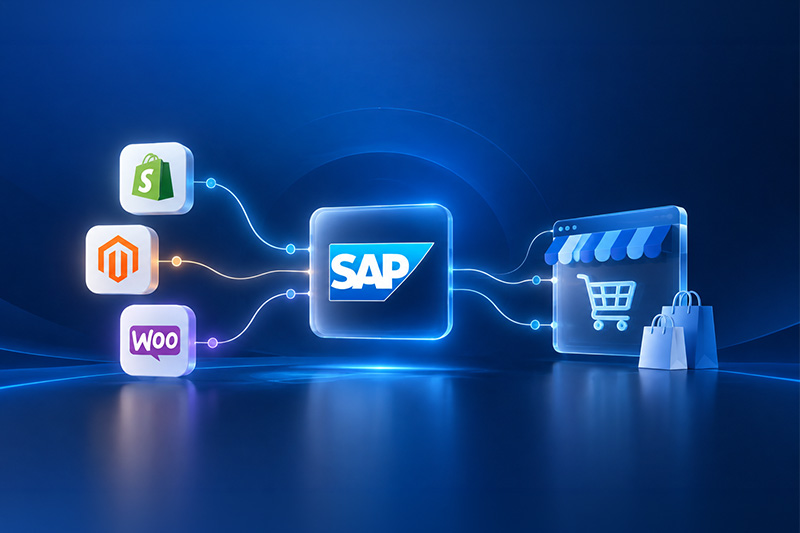
Yes. SAP Business One Cloud integrates with Shopify, Magento, WooCommerce, and other eCommerce platforms. Orders, inventory levels, customer information, and fulfillment processes can be synchronized automatically.Can SAP Business One Cloud support multiple warehouses?
Absolutely. The platform includes advanced inventory and warehouse management capabilities that allow businesses to manage multiple locations while maintaining real-time visibility into stock levels.Is SAP Business One Cloud secure?
Yes. When hosted on SAP-certified Microsoft Azure infrastructure, SAP Business One Cloud benefits from enterprise-grade security, disaster recovery, compliance controls, and continuous monitoring.What is the difference between SAP Business One Cloud and SAP S/4HANA?
SAP Business One Cloud is designed for small and medium-sized businesses. SAP S/4HANA targets large enterprises with highly complex global operations, extensive compliance requirements, and large-scale transaction volumes. For most SMEs, SAP Business One Cloud provides all required functionality while remaining significantly more cost-effective and easier to implement.Why choose a certified SAP Business One Partner?
ERP success depends heavily on implementation expertise. A certified SAP Business One Partner such as Ingold Solutions provides:- Licensing guidance
- Business process consulting
- Cloud hosting
- Data migration
- User training
- Ongoing support
Final Thoughts: Why SAP Business One Cloud Continues to Lead the SME ERP Market
For growing businesses, operational complexity often increases faster than expected. What starts as a handful of disconnected applications eventually becomes a barrier to growth. Finance operates separately from sales. Inventory data becomes unreliable. Reporting takes too long. Decision-makers struggle to access accurate information when they need it most. SAP Business One Cloud solves these challenges by creating a unified platform that connects every critical business process. Its combination of:- Financial management
- Inventory control
- Procurement automation
- Customer management
- Business intelligence
- AI-powered innovation
- Cloud scalability







 Applicable for Package
 Optional