


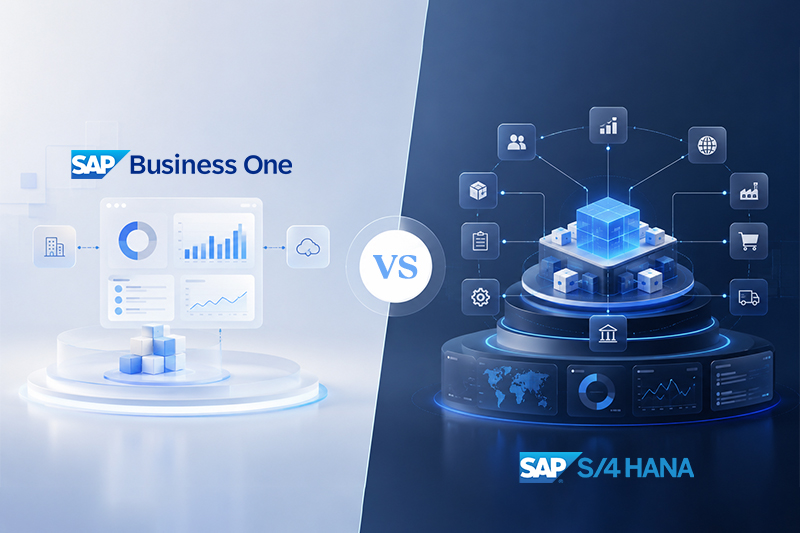
SAP Business One vs SAP S/4HANA: Which One Does Your Business Actually Need?
If you’ve started researching SAP, you’ve probably hit this question within the first hour. Both SAP Business One and SAP S/4HANA come from the same company. Both are serious ERP systems. Both will connect your finance, inventory, sales, and operations into a single platform. So what’s the difference — and which one is right for you?
The honest answer is that they’re built for different sizes of business, different levels of operational complexity, and different budget realities. Choosing the wrong one doesn’t mean you get a lesser version of what you need — it means you either overpay for features you’ll never use, or you constrain a growing business with a system that can’t keep up. Getting this decision right matters. This guide explains exactly how they differ, who each one is built for, and how to make the call.
Ingold Solutions is a certified SAP Silver Partner with implementation experience across both platforms and 11 industry verticals. The perspective here isn’t theoretical. It’s what we’ve seen work — and what we’ve seen go wrong — across real implementations with real businesses.
| 83,000+ companies run SAP Business One globally SAP, 2025 | 44,800+ companies use SAP S/4HANA worldwide Enlyft, 2026 | 8–12wks typical SAP Business One go-live time ERP Research, 2025 | $75K+ S/4HANA implementation starts from Top10ERP, 2026 |
What Are SAP Business One and SAP S/4HANA?
They’re both ERP platforms made by SAP — but they occupy completely different positions in SAP’s product portfolio, and they were built with different users in mind from the ground up.SAP Business One
SAP Business One — often called SAP B1 — is SAP’s dedicated ERP for small and medium-sized businesses. It runs in more than 170 countries and is used by over 83,000 companies worldwide. The system covers finance, inventory, purchasing, sales, CRM, production, and reporting in a single integrated platform. It’s designed to be implemented quickly, managed without a large in-house IT team, and priced in a way that makes sense for businesses that aren’t running hundreds of millions in revenue. A typical SAP Business One implementation goes live in 8 to 16 weeks. That’s not a rough estimate — that’s the real-world experience of businesses with 10 to 250 users implementing across standard modules.SAP S/4HANA
SAP S/4HANA is SAP’s next-generation enterprise ERP — launched in 2015 and built on SAP’s in-memory HANA database. It’s designed for large and complex organisations: global operations, multiple legal entities, embedded AI and predictive analytics, advanced supply chain management, and real-time financial processing at scale. Implementation timelines typically run from 6 to 24 months, and starting costs run from $75,000 upward for implementation services alone — before licensing, infrastructure, and ongoing support are factored in. It’s a serious investment, and it’s built for businesses that have the scale to need and justify it.SAP Business One vs SAP S/4HANA: Side-by-Side Comparison
Here is how the two systems compare across the criteria that matter most when making an ERP decision.| SAP Business One | SAP S/4HANA | |
| Target size | 10–250 users, SMEs with revenue up to $1B | 500–100,000+ users, mid-market to large enterprise |
| Primary use case | Core ERP for growing businesses: finance, inventory, CRM, sales, purchasing | Complex global operations, multi-entity, predictive analytics, embedded AI |
| Implementation | 8–16 weeks for standard deployments | 6–24 months depending on scope and complexity |
| Implementation cost | From €500 (Ingold Basic package) to €4,900+ | From $75,000 upward for implementation services alone |
| Licence cost | From €45/user/month (cloud, incl. hosting) | From $200/user/month; minimum 15 users required |
| Database | SAP HANA or Microsoft SQL Server | SAP HANA only — in-memory architecture required |
| Cloud option | Yes — cloud, on-premise, or hybrid | Yes — public cloud, private cloud, or on-premise |
| IT requirement | Low — managed by SAP partner | High — requires dedicated project teams and experienced consultants |
| Ecommerce | Magento, Shopify, WooCommerce integration | Enterprise-level ecommerce integrations available |
| GoBD / GDPR | Built-in for compliant markets (via partner config) | Built-in for compliant markets |
| Upgrade path | Can migrate to S/4HANA as the business grows | Full enterprise platform — scale within the system |
| Best for | SMEs, subsidiaries of larger companies, fast-growth businesses needing rapid deployment | Multinationals, complex manufacturing, global compliance requirements |
The Key Differences That Actually Matter
1. Company size and complexity
This is the primary differentiator and the one that resolves most of the confusion. SAP Business One is designed for businesses with fewer than 500 employees and revenue under $1 billion. SAP S/4HANA is designed for companies where that scale has already been exceeded — or where operational complexity (global supply chains, multiple legal entities, advanced manufacturing) demands something more. The practical reality is that most businesses asking ‘which SAP should I use’ are asking from a position where SAP Business One is the correct answer. A 40-person distribution company, a 90-person wholesale operation, a 200-person manufacturer — these businesses have sophisticated ERP needs that SAP Business One handles completely. Choosing S/4HANA for that scale doesn’t get you more of what you need. It gets you complexity and cost you’re not positioned to absorb.2. Implementation speed and risk
Speed matters because every month spent implementing is a month the business isn’t running on the new system. SAP Business One implementations run 8 to 16 weeks for standard deployments. A 5 to 15-user deployment covering core financials and inventory can go live in 8 to 12 weeks. S/4HANA implementations typically run 6 to 24 months, require larger project teams, and involve significantly higher risk of delay. For an SME with a finite IT budget and a business that can’t absorb 18 months of implementation overhead, this difference is decisive.3. Cost: total and predictable
The licensing comparison is clear. SAP Business One through Ingold Solutions starts from €45 per user per month on the cloud subscription plan, including Azure hosting. SAP S/4HANA starts from $200 per user per month with a minimum of 15 users required. But the more significant cost difference is in implementation and ongoing management. S/4HANA implementation services typically start at $75,000, and the requirement for large, experienced project teams means consulting costs accumulate quickly. SAP Business One’s simpler architecture means fewer consultants, shorter timelines, and a faster return on investment.4. Functionality: what each system actually covers
SAP Business One covers the full range of core ERP functionality: financial management with GoBD-compliant accounting, inventory and warehouse management, purchasing and supply chain, sales and order management, CRM, and business intelligence with customisable reporting. For the vast majority of SMEs, this is everything they need. SAP S/4HANA goes significantly further in areas of complexity: global financial consolidation across hundreds of legal entities, predictive supply chain planning with embedded AI, advanced manufacturing execution, and the full suite of SAP’s industry-specific solutions. S/4HANA also integrates with SAP’s Business Technology Platform, allowing organisations to extend processes and drive incremental innovation beyond what any packaged SME ERP can offer. But these are capabilities that require enterprise-scale operations to use — and enterprise-scale budgets to justify.5. The upgrade path
One of the most common questions from fast-growing businesses: ‘If we start with SAP Business One, can we move to S/4HANA later?’ The answer is yes — and it’s a path SAP has specifically structured. Businesses can start on SAP Business One and migrate to S/4HANA as they scale, with SAP maintaining compatibility to support that transition. Many multinationals run S/4HANA at headquarters and SAP Business One in smaller subsidiaries — a deployment model that itself confirms both systems’ fit for their respective tiers.Which SAP system is right for you? A quick decision guide
You have 10–250 employees → SAP Business One You need to go live within 3–6 months → SAP Business One Your ERP budget is under $250,000 total → SAP Business One You operate across multiple countries with separate legal entities → Consider S/4HANA You have 500+ users and enterprise-level complexity → SAP S/4HANA You want to start now and scale toward S/4HANA later → SAP Business One, with a structured upgrade planWhy Work with Ingold Solutions for SAP Business One
Ingold Solutions is a Berlin-based SAP Silver Partner with certified implementation experience across SAP Business One and 11 industry verticals — including wholesale, manufacturing, logistics, pharma, chemicals, retail, and food. For most of the businesses that come to us with the B1 vs S/4HANA question, the answer is SAP Business One — and we can take them from that decision to a live system in under 16 weeks. What distinguishes us from a generic SAP partner is the integration of ERP and cloud infrastructure under one team. SAP Business One through Ingold Solutions runs on SAP-certified Microsoft Azure HANA infrastructure — which means the same partner that configures your ERP also manages the environment it runs on. No handoff between an ERP consultant and a separate hosting provider. No gaps in accountability when something needs attention. For businesses with cross-border operations — particularly those expanding into or operating across multiple regions — Ingold Solutions holds dual SAP Silver Partner status and can implement SAP Business One as a single coherent system across multiple entities, with local compliance configurations handled within the same deployment. Ingold Solutions — SAP Silver Partner SAP Silver Partner: Certified in both Germany and India Microsoft Solutions Partner: Azure hosting — managed end to end ISO 9001 certified: Quality-controlled implementation and support Industries covered: 11 verticals: wholesale, manufacturing, logistics, pharma, retail, food, chemicals, and more Implementation packages: From €500 (Basic) to €4,900 (Professional) — free trial available Free consultation: No credit card, no commitment — we assess fit before any package is recommendedFREQUENTLY ASKED QUESTIONS
SAP Business One vs S/4HANA: The Questions We Hear Every Week







 Applicable for Package
 Optional