Most small and mid-sized businesses reach a point where the tools they started with stop working. The accounting package and the stock system do not share data. Sales are tracked in a spreadsheet that three people are editing simultaneously. Month-end reporting takes longer than it should because someone is pulling numbers from four different places and reconciling them by hand.
This is the moment SAP Business One was built for. Not the moment a company needs a full enterprise transformation — the moment before that, when a growing business needs one system that covers everything, runs reliably, and does not require an IT department to keep it functional.
Used by more than 83,000 SMBs globally across 170+ countries, SAP Business One is one of the most widely deployed ERP platforms at the small and mid-market level. This guide covers what it does, which modules matter, how it performs across industries, and what to look for in an implementation partner — specifically, why that last point determines more of the outcome than most businesses anticipate.
What Is SAP Business One?
SAP Business One is SAP's dedicated ERP system for small and mid-sized businesses. Where SAP's larger platforms — S/4HANA and Business Suite — are engineered for enterprise-scale operations with hundreds of users and complex multi-system landscapes, SAP Business One is designed to run an entire SMB on a single, integrated platform.
The product has been available for over two decades and is localised for 170+ countries in 28 languages, with built-in tax and regulatory compliance for each supported jurisdiction. This is not a minor detail. For any business operating across borders — or planning to — ERP localisation is one of the most expensive problems to solve after the fact. SAP Business One builds it in from the start.
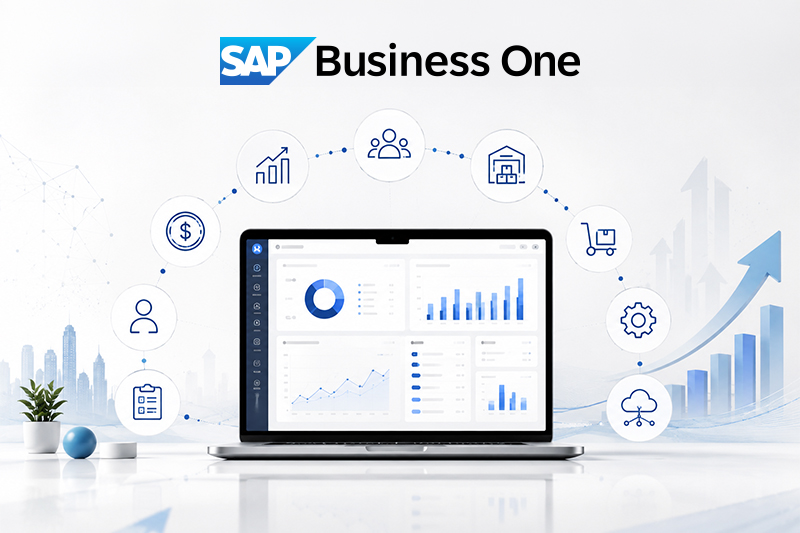
It covers finance, sales, purchasing, inventory, light manufacturing, CRM, and business intelligence in a single system. Data entered in one area is immediately available everywhere else. A purchase order raised in procurement triggers a corresponding entry in accounts payable. A customer payment recorded in finance updates the CRM record automatically. The principle is straightforward: one system, one version of the data, no reconciliation required.
Market context: The SAP Business One consulting market is valued at $0.49 billion in 2025 and projected to reach $1.19 billion by 2034, growing at a compound annual rate of 10.5%. North America currently leads with 41% of market share. The trajectory reflects a platform in active, sustained growth — not a legacy product in decline.
SAP Business One Modules: What Each One Does
The platform is structured around six core functional areas. Understanding what each covers — and how they connect — is the most practical way to evaluate whether SAP Business One fits the way your business actually operates.
Financial Management
This is the most foundational module, and the one most businesses feel the benefit of first. SAP Business One automates the full accounting cycle: journal entries, accounts receivable, accounts payable, bank reconciliation, fixed asset management, and multi-currency transactions. Financial reporting runs from real-time data, which means managers are looking at current figures rather than last week's export.
The controlling sub-module goes further: cash flow tracking, budget management, and project cost monitoring in a single interface. For businesses where cash flow visibility has historically been a manual, retrospective exercise, this is a significant operational shift.
Sales and Customer Management
The sales module covers the complete customer lifecycle — from first contact through to post-sale service. Opportunity management tracks leads and pipeline throughout the sales cycle. CRM functionality centralises all customer data, with synchronisation to Microsoft Outlook so that communication history and contact records stay aligned without manual duplication.
Marketing campaign management, service contract administration, and warranty tracking sit within the same module — which means the handover from sales to service happens within the same system rather than requiring a separate tool. For SMBs that have been managing sales in one place and service calls in another, the consolidation eliminates a class of operational problems.
Mobile sales functionality extends access to the field. Sales teams working remotely can manage leads, check stock levels, and place orders from iOS or Android devices without needing to be connected to a VPN or office system.
Purchasing and Inventory Control
The procurement cycle — from requisition to goods receipt to invoice — runs within a single, documented workflow. Every step creates a corresponding record, which means audits are straightforward and approval chains are visible. Multi-currency purchasing is handled natively.
Inventory management goes beyond basic stock tracking. SAP Business One supports batch management, serial number tracking, barcode scanning, and material requirements planning — capabilities that sit firmly in the enterprise tier of most competing SMB ERP platforms but are built into SAP Business One as standard. The result: fewer stockouts, more accurate purchasing decisions, and warehouse operations that do not depend on a separate system or manual counts.
Ingold Solutions implementation note:
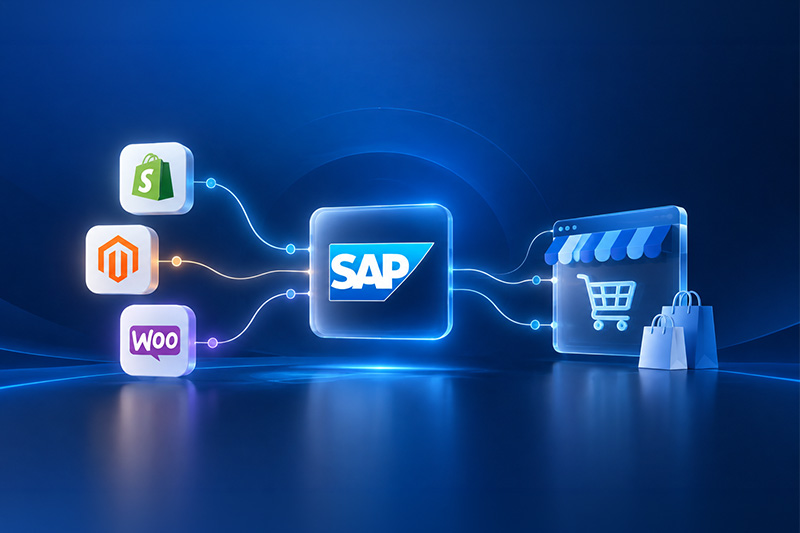
Ingold Solutions configures the purchasing and inventory modules specifically for each client's warehouse and procurement workflow — including integration with Shopify, Magento, and WooCommerce for businesses that manage both physical and online inventory simultaneously.
Business Intelligence and Reporting
One of the most regularly cited advantages of SAP Business One in user reviews is the quality of the reporting infrastructure. Custom dashboards, interactive KPIs, and real-time analytics are built into the platform rather than requiring a separate BI licence or third-party tool.
The platform integrates with standard Microsoft Excel functionality for analytical work that benefits from spreadsheet flexibility. Drag-and-relate navigation lets users move between related data sets without building queries. Workflow-based alerts flag anomalies or thresholds automatically — a stock level dropping below reorder point, a payment overdue, a budget line approaching its limit.
For management teams that have been relying on static monthly reports to make operational decisions, the move to real-time analytics represents a genuine change in how the business is run, not just how it is tracked.
Industry-Specific Capabilities
SAP Business One is used across a wide range of SMB sectors including manufacturing, retail, wholesale distribution, professional services, and consumer goods. The platform includes industry-specific process templates and functionality built around the operational realities of each sector:
- Manufacturing: bill of materials, production orders, material requirements planning, and quality control. SMBs in this sector use SAP Business One to shrink supply chain costs, reduce cycle times, and manage production scheduling against real-time inventory data.
- Retail: point-of-sale integration, real-time customer insights, and end-to-end operations management from supplier to shelf. The platform's inventory module is particularly strong here — barcode scanning, automated reorder triggers, and stock visibility across multiple locations.
- Wholesale Distribution: flexible order management, supplier integration, and inventory optimisation across a distribution network. SAP Business One handles the volume and complexity of multi-location wholesale operations within the SMB tier.
- Professional Services: project management, resource planning, billing, and service delivery tracking. Firms that bill by project or retainer use the controlling module to track profitability at the engagement level rather than just the company level.
SAP Business One vs. Other SMB ERP Options
The SMB ERP market is not short of options. NetSuite, Microsoft Dynamics 365 Business Central, Odoo, and a range of others compete in the same space. The honest comparison is worth making rather than avoiding.
SAP Business One's primary advantages over the alternatives are depth of functionality, global localisation, and long-term product stability. The platform covers light manufacturing natively — something many SMB ERP systems require an add-on to handle. The 170-country localisation means multi-market businesses do not need separate systems or workarounds for different tax jurisdictions. And SAP's 50-year history as a software business, combined with a published product roadmap, offers a level of longevity assurance that newer platforms cannot easily match.
The trade-offs are real too. SAP Business One carries a higher licence cost than some alternatives, and implementation complexity means the partner relationship matters more than with simpler platforms. User interface design has historically been a criticism — the system is powerful but not always immediately intuitive for first-time users.
Both of those considerations are addressed by the right implementation partner. A partner who configures the system well, trains users properly, and provides accessible ongoing support changes the experience considerably. Which brings us to the part most ERP conversations underweight.
Why the Right SAP Partner Changes Everything
SAP provides the software. The partner provides everything else — implementation, configuration, data migration, training, and support. For most SMBs, the implementation partner is the face of SAP Business One for the entire duration of the relationship.
Ingold Solutions GmbH is a certified SAP Silver Partner based in Berlin, specialising in SAP Business One implementations for small and mid-sized businesses across Europe and internationally. The company holds ISO 9001 certification for quality management and ISO 27001 certification for information security — both independently audited, not self-declared.
The SAP Business One consulting market now operates through a network of 1,000+ certified global partners, ranging from large international firms to boutique specialists. Ingold Solutions sits firmly in the specialist category — SAP Business One for SMBs is the focus, not one practice area among many. The depth of product knowledge that comes with that focus shows in implementation quality and in the accuracy of advice during the critical pre-sales and scoping phase.
The All-Inclusive Cloud package from Ingold bundles licensing, Azure hosting on SAP HANA-certified infrastructure, updates, backups, firewall protection, and direct support access into a single predictable monthly fee. Starter licences from €45 per user per month including hosting, with no hidden infrastructure costs and a 24-hour deployment window for standard configurations.
Ingold Solutions operates as an SAP Run Partner —
authorised to deliver SAP Business One Cloud with direct access to the SAP partner support infrastructure. This means escalation paths to SAP directly when required, rather than a partner working from documentation alone.
Deployment: Cloud vs. On-Premise
SAP Business One is one of the few SMB ERP platforms that continues to offer both deployment models with full feature parity. The choice between cloud and on-premise is worth thinking through rather than defaulting to either.
Cloud deployment — as offered through Ingold Solutions on Microsoft Azure — removes infrastructure responsibility from the business entirely. No servers, no patch management, no hardware replacement cycles, no in-house IT overhead. Updates happen automatically. Access is browser-based from any device. The monthly subscription replaces capital expenditure with a predictable operating cost.
On-premise deployment suits businesses with existing server infrastructure that still has commercial life, specific data residency requirements, or complex customisation needs. The feature set is identical. The infrastructure management stays in-house.
For the majority of first-time SAP Business One implementations among SMBs without existing enterprise infrastructure, cloud is the faster, simpler, and more cost-effective starting point. The five-year total cost of ownership comparison, when hardware procurement, maintenance, and IT resource are included, typically favours cloud by a meaningful margin.
Frequently Asked Questions: SAP Business One
What is SAP Business One used for?
SAP Business One is an ERP system used by small and mid-sized businesses to manage finance, sales, purchasing, inventory, CRM, and business intelligence from a single integrated platform. It replaces disconnected point solutions — separate accounting software, stock systems, CRM tools — with one system where data flows between departments in real time. When an order is placed, the inventory updates immediately. When a payment is received, the CRM record reflects it. No manual reconciliation, no data re-entry.
How many companies use SAP Business One globally?
More than 65,000 SMBs across 170+ countries use SAP Business One. The platform is localised for each supported market with built-in tax rules, regulatory compliance, and language support across 28 languages. It is also widely deployed as the subsidiary ERP within larger enterprise groups — sitting alongside SAP S/4HANA at headquarters, with pre-built integration templates connecting the two.
What are the main SAP Business One modules?
SAP Business One covers six core functional areas: Financial Management (accounting, controlling, fixed assets, banking and reconciliation); Sales and Customer Management (CRM, opportunity tracking, service contracts, mobile sales); Purchasing and Inventory Control (procurement workflow, MRP, batch and serial tracking, warehouse management); Business Intelligence (dashboards, real-time analytics, Excel integration, KPI alerts); Industry-Specific Capabilities for manufacturing, retail, wholesale distribution, and professional services; and Mobile Functionality through the SAP Business One Sales app for iOS and Android.
What is the difference between SAP Business One and SAP S/4HANA?
SAP Business One targets standalone SMBs and enterprise subsidiaries — typically companies with 10 to 250 employees requiring an integrated ERP without large-enterprise complexity or cost. SAP S/4HANA is SAP's next-generation platform for large enterprises, with significantly higher licence costs, longer implementation timelines, and greater customisation depth. Business One is simpler to deploy, faster to configure, and substantially lower in total cost of ownership. Many S/4HANA customers choose Business One specifically for their subsidiaries, using pre-built integration templates to connect both systems.
Can SAP Business One integrate with e-commerce platforms?
Yes. SAP Business One integrates with Shopify, Shopify Plus, Magento, and WooCommerce. A live integration means that orders placed online flow directly into the ERP — inventory levels update the moment a sale is made, fulfilment is triggered automatically, and customer records stay synchronised across both systems. This eliminates the manual reconciliation between online storefront and ERP that disconnected systems require. Ingold Solutions specialises in configuring these integrations as part of its implementation service.
Is SAP Business One available in the cloud?
Yes. SAP Business One is available as a fully cloud-hosted deployment running on Microsoft Azure infrastructure with SAP HANA Server certification. Through Ingold Solutions, the cloud version starts from €45 per user per month including hosting for Starter Package users. The cloud version carries identical functionality to the on-premise version — the difference is that the infrastructure is managed entirely by the hosting partner, with automatic updates, automated backups, and enterprise-grade security included as standard. Deployment for standard configurations is completed within 24 hours.
Which industries use SAP Business One?
SAP Business One is actively used across manufacturing, retail, wholesale distribution, professional services, logistics, consumer goods, healthcare, and education. The platform includes industry-specific process templates for the most common SMB sectors. More than 500 industry add-ons are available through the SAP Partner Edge programme, extending the core platform for niche sector requirements. Ingold Solutions has active implementations across manufacturing, retail, wholesale, and professional services specifically.
How long does SAP Business One implementation take?
Implementation timelines depend on deployment model, customisation scope, and the complexity of any data migration from existing systems. Cloud deployments of standard configurations through Ingold Solutions go live within 24 hours. More complex projects — involving significant customisation, multiple locations, or large-scale data migration — typically run over four to twelve weeks. The partner's project management discipline and product knowledge are the primary factors determining whether implementation stays on schedule and within budget.
What does an SAP Business One licence cost?
SAP Business One licence costs vary by deployment model and user type. Through Ingold Solutions, cloud subscription pricing starts at €45 per user per month including Azure hosting for Starter Package users (up to five users). Limited User licences — covering role-specific CRM, Finance, or Logistics access — start from €55 per month including hosting. Professional User licences, with unrestricted access to all modules, start from €105 per month including hosting. Perpetual licence options are also available under a one-time purchase model. All plans run on a 12-month minimum contract with a three-month cancellation notice thereafter.
What role does an SAP partner play in the implementation?
The SAP partner is responsible for the entire implementation experience — everything beyond the software itself. This includes system configuration to match the business's specific processes, migration of data from existing systems, user training across all modules, go-live support, and ongoing maintenance and helpdesk access. The quality of the partner relationship determines the quality of the ERP deployment far more than most businesses anticipate before they go through the process. A partner with deep SAP Business One specialism, like Ingold Solutions, will identify configuration decisions early that a generalist IT firm catches late — or misses entirely.
Getting Started with SAP Business One Through Ingold Solutions
The decision to implement an ERP system is one of the more consequential choices a growing business makes. The platform matters. The partner matters equally. A system configured well by someone who understands both the software and your industry type will outperform a technically superior system configured carelessly every time.
Ingold Solutions offers a free trial of SAP Business One before any financial commitment. No credit card, no sales pressure — just the platform configured for your business type, with expert support available if you need it during the evaluation period.
Explore SAP Business One with Ingold Solutions at ingoldsolutions.com, or book a free consultation to discuss your requirements directly with the team.









 Applicable for Package
 Optional