By IngoldMay 29,2026
There is a statistic that should make every ecommerce retailer stop and think carefully about where they are spending their technology budget right now. According to McKinsey’s 2025 State of AI report and follow-up data from Stord in 2026, 89% of retailers have adopted AI in some form. Only 7% have successfully scaled it to the point where it generates measurable business impact.
That 82-point gap between adoption and results is not an AI problem. The models are capable. The tools are available. The problem is that most of the AI sitting inside retail and ecommerce businesses is being asked to work with data it fundamentally cannot trust. Fragmented systems, batch-synced inventory, siloed customer records, and disconnected pricing engines are producing forecasts, recommendations, and automations that are only as accurate as the last time someone remembered to export a spreadsheet.
For ecommerce retailers specifically, this has a very direct commercial consequence. Adobe Digital Insights reported that traffic from generative AI to retail websites grew 4,700% year-on-year by mid-2025. Shoppers arriving through AI discovery channels convert 27% more and bounce 27% less than any other source. These are buyers who have already been told what to expect before they land on your site. If your inventory, pricing, or stock status disagrees with what the AI told them, that trust disappears in seconds. The conversion does not happen. The return visit does not happen either.
The retailers who will pull ahead in AI-powered commerce are not the ones with the most sophisticated models. They are the ones who sorted out their operational data first. And that starts with a unified commerce ERP — specifically, SAP Business One Cloud.
89% adopted. 7% scaled.
The maturity gap between AI adoption and actual scaled results in retail is not a technology problem. It is a data infrastructure problem.
McKinsey State of AI 2025 / Stord 2026
The Data Quality Crisis Nobody Is Talking About Honestly
Ask the people responsible for your business data whether they trust it and the answer is rarely what leadership assumes. A 2025 MarketingOps study found that only 16% of RevOps professionals trust their own data accuracy. Not 60%. Not 40%. Sixteen per cent.
That number describes the environment in which most AI tools are currently operating inside retail businesses. Recommendation engines pulling product data from a catalogue that was last fully reconciled eight months ago. Demand forecasting tools ingesting inventory figures that are accurate as of yesterday morning’s batch sync. Customer segmentation built on CRM records that do not include any purchase history from the last six weeks because the integration broke and nobody noticed.
The Stanford 2026 AI Index found that 74% of respondents named data inaccuracy as their top AI risk — up 14 percentage points in a single year, and now ranking above cybersecurity and regulatory compliance as the primary concern. That shift in sentiment reflects what practitioners are experiencing in the field: the AI is behaving exactly as designed. It is the data it has been given that is failing.
The AI is behaving exactly as designed. It is the data it has been given that is failing.
For ecommerce retailers, the data inaccuracy problem almost always has the same root cause: systems that were implemented at different times, by different teams, for different purposes, and that have been connected together through integrations that were built to cope rather than built to perform. The ERP sits furthest from the customer-facing systems and gets updated last. It becomes the source of truth that nobody fully trusts, which means the AI built on top of it is working with a foundation that its own owners would not stake a business decision on.
AI Agents Break Down Completely With Disconnected Inventory
The most immediate failure mode for AI in ecommerce is inventory. It is also the failure mode that damages customer relationships most directly and most visibly.
An AI-powered recommendation engine surfaces a product. A demand forecasting tool reorders stock based on its prediction. An AI chatbot confirms availability to a customer. If any of these agents is pulling inventory data from a source that is even slightly out of sync with the actual warehouse position, the results range from mildly embarrassing to commercially serious. Overselling stock that has already gone. Reordering products that are already sitting in an overflow area that the system has not mapped. Confirming next-day delivery on items that are in a supplier's warehouse, not yours.
The Commerce Team Global’s April 2026 analysis is direct about this: competitive advantage in AI-enabled commerce no longer comes from access to AI tools. It comes from how effectively AI is embedded into the commerce operating model. Most retail businesses follow the same pattern — each AI initiative works in isolation. The recommendations engine does not know what the promotions engine has excluded. The chatbot does not know what the forecasting tool has flagged. The customer experience becomes incoherent because the AI features are fighting each other silently, each working from a slightly different version of the truth.
Connecting all of these agents to a single, trusted, real-time data source is not a nice optimisation for later. It is a prerequisite for AI that actually works at the operational level. That single source is the ERP — and specifically, an ERP that is always on, always current, and always accessible to the systems built on top of it.
Bad ERP Equals Bad AI Forecasting. The Maths Is Simple.
Demand forecasting is one of the highest-value applications of AI in ecommerce. Get it right and you reduce carrying costs, improve fulfilment rates, and avoid the capital destruction of excess stock. Get it wrong and you are systematically ordering too much of the wrong things and too little of the right ones, guided by a model that is confident in its own errors.
The quality of a demand forecast is entirely dependent on the quality of the historical and real-time data feeding it. That data lives in the ERP. If the ERP holds inaccurate cost prices, incomplete supplier lead times, stock figures that were last verified during a manual count six months ago, and purchase order histories with gaps where transactions were processed outside the system, the forecast the AI produces will reflect all of those errors with complete statistical confidence.
Research from Apptad’s 2026 analysis of enterprise AI performance found that organisations with strong data integration achieve 10.3x ROI from their AI investments. Organisations with poor data connectivity achieve 3.7x. That is not a marginal difference. It is the difference between AI as a genuine competitive advantage and AI as a cost centre that never quite delivers what was promised in the business case.
10.3x vs 3.7x
ROI from AI investments: organisations with strong data integration versus those with poor connectivity.
Apptad Enterprise AI Performance Analysis, 2026
SAP Business One Cloud eliminates the core sources of this discrepancy. Financial postings, inventory movements, purchase orders, sales orders, and customer transactions all happen in the same system, in real time. There is no batch sync introducing a twelve-hour lag between what happened in the warehouse and what the forecasting tool thinks happened. There is no reconciliation task where someone aligns three different systems before the weekly planning meeting. The data the AI sees is the data the business is actually operating on.
Why Shopify Alone Cannot Solve This
Shopify is an excellent ecommerce platform. For businesses at the right stage of growth, it handles the storefront well, provides solid checkout functionality, and has a broad app ecosystem. What it is not, and has never claimed to be, is an ERP.
The distinction matters enormously in the context of AI readiness. Shopify’s data model covers what happens on the storefront: products, orders, customers, payments, and some inventory tracking. What it does not natively hold is your supplier lead times, your landed costs, your chart of accounts, your purchase order history, your multi-warehouse stock positions, your company-specific B2B pricing tiers, or your inter-entity financial structure if you operate across multiple legal entities.
This means an AI tool built on Shopify data alone is working with a partial view of the business. It can see what sold. It cannot see what it cost to source, what the margin actually was, what the supplier reliability has been over time, or whether the stock that replenished that order came from the right warehouse at the right cost. All of that operational context — the context that turns a sales signal into an intelligent forecast — lives in the ERP.
Shopify can tell you what sold. It cannot tell you what it cost, where it came from, or whether the business made money on it. That context lives in the ERP.
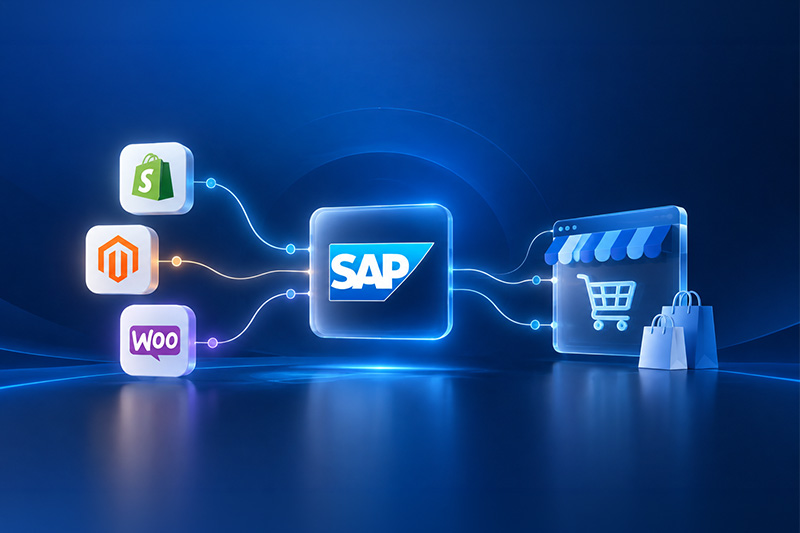
Businesses running Magento, Shopify, or Shopware connected directly to SAP Business One Cloud via a native integration — as Ingold Solutions delivers using in-house-built connectors without middleware — give their AI tools access to the full operational picture. Every order that lands on the storefront is immediately visible in the ERP. Every inventory movement in the ERP is reflected on the storefront in real time. The AI is not working with a subset of the business data. It is working with all of it.
Unified Commerce Needs Unified Data. SAP Business One Cloud Delivers It.
The phrase ‘unified commerce’ gets used loosely. In practice, it means one thing: every customer-facing and operational system drawing from the same data in real time. The storefront, the warehouse, the purchasing function, the finance team, and the AI tools sitting across all of them all working with the same version of the truth at the same moment.
SAP Business One Cloud is the operational core that makes this possible for small and mid-sized ecommerce businesses. Finance, inventory, purchasing, sales, CRM, and reporting all centralised in a single cloud environment, hosted on Microsoft Azure with 99.95% uptime, and accessible in real time from any location. The AI tools your business uses — whether for forecasting, personalisation, chatbots, or pricing optimisation — have a data foundation that is always current, always consistent, and always trustworthy.
For ecommerce businesses in the German and DACH market, Ingold Solutions’ approach as a certified SAP partner and e-commerce integration specialist brings this together through a single accountable relationship. SAP Business One Cloud implementation, Microsoft Azure hosting, and native connectors for Magento, Shopify, and Shopware are all handled by the same team. The ERP and the storefront are configured with knowledge of each other. The AI tools built on top of them are working on data that has been designed to be reliable, not just data that happens to be available.
Frequently Asked Questions
Q: Can I run AI tools on my current systems without moving to an ERP like SAP Business One Cloud?
Technically, yes. Practically, the results will reflect the quality of the data those systems hold. The 82-point gap between AI adoption and scaled AI results in retail is primarily a data quality and integration problem, not a tooling problem. AI running on fragmented, batch-synced data produces outputs that look impressive in demos but disappoint in production. An AI ecommerce ERP like SAP Business One Cloud removes the data quality ceiling that is limiting most AI investments in retail right now.
Q: How does SAP Business One Cloud specifically support AI readiness for ecommerce businesses?
SAP Business One Cloud holds all operational data — inventory, purchasing, sales, finance, and customer management — in a single, real-time environment. AI forecasting tools, recommendation engines, and automation agents pulling data from SAP Business One Cloud are working with information that reflects the actual current state of the business. There are no batch sync delays, no reconciliation gaps, and no data silos introducing conflicting signals. This is the operational condition that allows AI to perform at the level its vendors promise.
Q: We run Shopify and are investing in AI tools. Do we actually need an ERP?
Shopify handles the storefront well. What it does not hold is the operational data — supplier lead times, landed costs, multi-warehouse positions, margin by product line, B2B pricing tiers — that AI forecasting and intelligence tools need to produce accurate outputs. If your AI tools are drawing only on Shopify data, they are working with a partial view of your business. Connecting Shopify to SAP Business One Cloud via Ingold Solutions’ native integration gives the AI access to the full operational picture, which is where the 10.3x versus 3.7x ROI difference in data-connected versus disconnected AI investments comes from.
Q: How does Ingold Solutions connect SAP Business One Cloud to our existing ecommerce platform?
Ingold Solutions has built in-house native connectors for Magento, Shopify, Shopware, and WooCommerce that connect directly to SAP Business One Cloud without middleware. Orders, inventory, pricing, and customer data synchronise in real time between the storefront and the ERP. Because the same team builds and maintains both the ERP implementation and the connector, the two sides of the integration are configured with knowledge of each other from the start — which removes the most common source of data discrepancy in ecommerce ERP integrations.
The AI Investment That Pays Off Is Built on Clean Data
The rush to adopt AI in ecommerce is understandable. The traffic numbers are real. The conversion uplift from AI-driven discovery is real. The competitive pressure from businesses that are already using it is real and growing. But the gap between the 89% who have adopted AI and the 7% who have scaled it is not closing through better models or bigger budgets. It is closing through better data infrastructure.
Retailers who get to unified commerce ERP first — who centralise their operational data in SAP Business One Cloud before building AI on top of it rather than after — are building on a foundation that multiplies the value of every AI investment that follows. The ones who bolt AI tools onto fragmented systems are building on sand. The tools work in isolation. They fight each other silently. And the gap between what was promised and what was delivered becomes the defining frustration of the technology budget conversation every quarter.
Ingold Solutions helps ecommerce businesses in the DACH market build the operational foundation that AI readiness actually requires. SAP Business One Cloud on Microsoft Azure, native ecommerce integrations without middleware, and the implementation expertise to make both work together from day one.










 Applicable for Package
 Optional