Getting SAP Business One to work with Magento is something a lot of businesses want these days. It helps automate ecommerce and just makes life easier. But just deciding to connect the two isn’t enough—you need to figure out the best way to do it.
Some companies go for a straight, native link between Magento and SAP Business One. Others bring in middleware or an iPaaS platform to handle data that needs to move between different systems. And if you’re already deep into the SAP ecosystem, their
SAP Business One Integration Framework (B1if) is another option.
Each method has distinct benefits. The right pick really comes down to your current IT setup, how complicated your business processes are, your future plans, and how much ongoing maintenance you’re willing to handle.
In this article, we’ll walk you through the main integration approaches, break down where each one really shines, and help you figure out which solution fits your business best.
Why Integration Architecture Is So Important
An integration can perform perfectly during testing and still create problems once the business starts relying on it every day. In many cases, the issue isn't the software—it's the way the integration was designed.
A common example is data ownership. Imagine Magento updates product prices while SAP Business One is also responsible for pricing. Or inventory changes in one system but isn't reflected correctly in the other. Before long, your sales team is working with one set of figures while customers see something completely different online.
That's why defining clear responsibilities from the beginning is essential. Decide which system manages products, pricing, inventory, customer information, and orders before any development starts. A well-planned integration architecture reduces errors, simplifies maintenance, and gives you a platform that can continue to grow as your business expands.
A well-designed architecture defines:
- Which system owns each type of data
- How information is synchronized
- How future updates will be managed
- How the solution will scale as transaction volumes grow
What Is a Native SAP Business One Magento Integration?
A native SAP Business One Magento integration connects Magento directly to SAP Business One without relying on third-party middleware to move or transform data.
Most modern native integrations communicate through the SAP Business One Service Layer, a RESTful, OData-compliant API that exposes SAP Business One business objects securely over HTTP. It supports JSON payloads, CRUD operations, scalability, and modern web development frameworks.
Typical synchronized data includes:
Instead of creating duplicate databases or manually exporting data, Magento communicates directly with SAP Business One using APIs.
What Is Middleware?
Middleware sits between Magento and SAP Business One as an intermediary.
Rather than allowing Magento to communicate directly with SAP Business One, every request passes through another application responsible for:
Popular middleware products include:
Middleware is often useful when multiple enterprise systems need to communicate simultaneously.
What Is iPaaS?
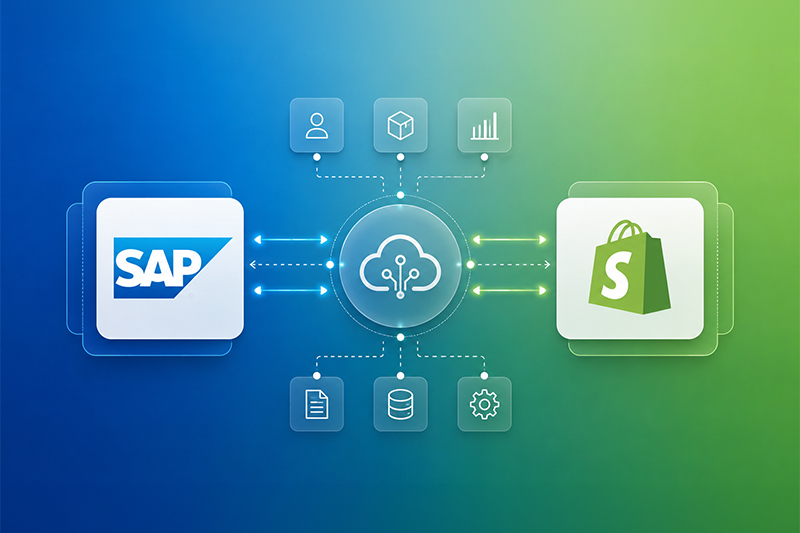
Integration Platform as a Service (iPaaS) is a cloud-based middleware platform.
Instead of hosting integration software yourself, you subscribe to an online platform that connects:
Examples include:
- Zapier (for lightweight scenarios)
iPaaS solutions simplify cloud integrations but usually introduce another layer that must be maintained.
What Is SAP Business One Integration Framework (B1if)?
B1if (SAP Business One Integration Framework) is SAP's own integration framework for connecting SAP Business One with internal and external applications. It provides orchestration, transformation, routing, and workflow capabilities and is part of the SAP Business One ecosystem.
While B1if is powerful, it generally requires specialized expertise and is often chosen for complex enterprise integration scenarios rather than straightforward ecommerce projects.
Understanding SAP Business One Service Layer
The Service Layer is the preferred integration technology for many modern SAP Business One implementations.
It provides:
- Support for web and mobile applications
Its architecture includes an OData parser, DI Core, session management, and load-balancing capabilities, allowing multiple Service Layer instances to run in parallel for improved performance and resilience.
Native SAP Business One Magento Integration vs Middleware
| Feature |
Native Integration |
Middleware |
iPaaS |
B1if |
| Direct SAP Communication |
✅ |
❌ |
❌ |
✅ |
| REST API Support |
✅ Service Layer |
Depends |
Depends |
Yes |
| Additional Software Layer |
No |
Yes |
Yes |
Yes |
| Infrastructure Complexity |
Low |
Medium |
Medium |
High |
| Performance |
High |
Medium |
Medium |
Medium |
| Real-Time Synchronization |
Excellent |
Good |
Good |
Good |
| Maintenance |
Low |
Medium–High |
Medium |
High |
| Scalability |
Excellent |
Good |
Good |
Excellent |
| Initial Cost |
Lower |
Medium |
Subscription |
Higher |
| Best For |
Magento + SAP B1 |
Multi-system environments |
Cloud ecosystems |
Enterprise SAP landscapes |
Comparing the Total Cost of Ownership
The implementation cost is only one part of the equation.
You should also consider:
A native SAP Business One Magento integration often has a lower long-term total cost because there are fewer components to maintain.
Middleware solutions may introduce additional licensing, hosting, and support costs over time.
Maintenance: The Hidden Cost of Integration
Many businesses underestimate the effort required to maintain an integration.
Every additional layer means:
Keeping the architecture simple generally reduces maintenance effort and speeds up issue resolution.
Scalability: Planning Beyond Today
Your integration should support your business five years from now—not just today.
Questions to ask include:
- Can it handle 100,000 products?
- Will it support multiple warehouses?
- Can it synchronize customer-specific pricing?
- Does it support multiple Magento stores?
- Will it perform during seasonal traffic peaks?
The SAP Business One Service Layer is designed with scalability in mind, supporting parallel processing and load balancing when deployed across multiple instances.
APIs: The Foundation of Modern Integrations
Modern ecommerce integrations rely heavily on APIs.
A robust SAP Business One Magento integration should expose:
Using standardized REST APIs makes integrations easier to maintain and extend over time.
Which Integration Approach Is Best?
There isn't a single answer for every business.
Choose a Native Integration if:
- Magento is your primary ecommerce platform.
- SAP Business One is your ERP.
- You want real-time synchronization.
- You prefer lower maintenance.
- You want fewer system dependencies.
Choose Middleware if:
- Multiple enterprise systems need orchestration.
- Complex transformation logic is required.
- Existing middleware infrastructure is already in place.
Choose iPaaS if:
- Your business relies heavily on SaaS applications.
- Cloud-first integration is a priority.
- You want pre-built connectors for multiple services.
Choose B1if if:
- Your organization already uses SAP's Integration Framework.
- You have experienced SAP integration specialists.
- You require advanced enterprise workflows.
How Ingold Solutions Approaches SAP Business One Magento Integration
At Ingold Solutions, we believe an integration should simplify your business—not create another system to manage.
Our SAP Business One Magento Integration is designed to connect Magento and SAP Business One through a native architecture that minimizes manual work, eliminates duplicate data entry, and automates key business processes. Product information, inventory, customer data, orders, and pricing remain synchronized, allowing your ERP and ecommerce platform to operate as one connected system.
Whether you're running a B2B portal, a B2C store, or both, our team helps you design an integration architecture that aligns with your current operations while supporting future growth.
Final Thoughts
The debate between Native SAP Business One Magento Integration vs Middleware isn't about which technology is universally better—it's about choosing the architecture that best fits your business.
If your objective is a straightforward, high-performance connection between Magento and SAP Business One, a native integration built on the SAP Business One Service Layer can reduce complexity, improve performance, and simplify long-term maintenance. For organizations managing a broader enterprise ecosystem with numerous connected applications, middleware or iPaaS may provide greater orchestration capabilities.
The most successful projects begin with one principle: define your business processes first, then select the integration architecture that supports them—not the other way around.






 Applicable for Package
 Optional