


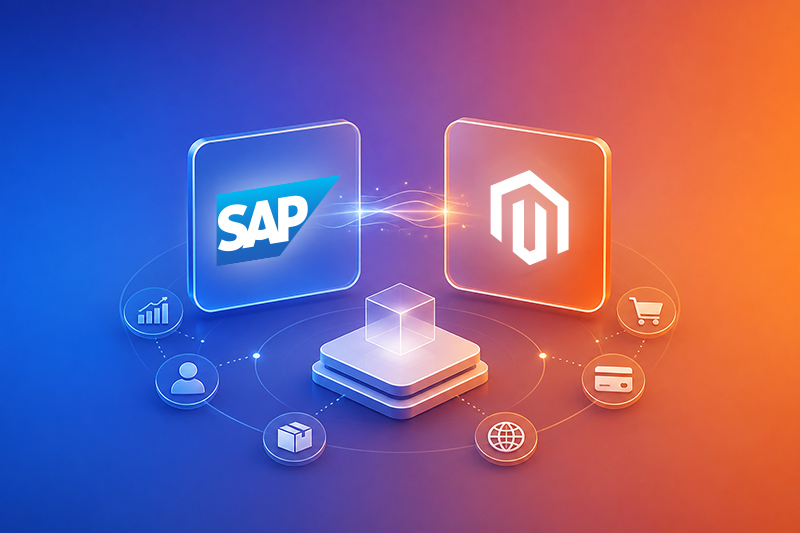
SAP Business One & Magento: The Complete Digital Commerce Stack for 2026
Picture the moment an order is placed on your Magento store at 11:47 on a Tuesday morning. A customer has picked their product, entered their address, completed payment. On your end, what happens next?
If your Magento store and your ERP are not integrated, the answer is: someone finds out. Eventually. They log into the back office, see the order notification, and begin a process that involves re-entering data into a second system, manually checking stock, raising a sales document, and updating fulfilment information that the customer is already wondering about. That process takes time. It introduces errors. It scales badly. And it is happening hundreds or thousands of times depending on your order volume.
Now picture a business where that Magento order, the moment it is placed, automatically creates a sales order in SAP Business One. Stock is reserved in real time. The fulfilment team gets the instruction without a human relay. The finance module captures the transaction. When the goods ship, the tracking number flows back to Magento and the customer gets their notification. Nobody re-keyed anything. Nobody manually reconciled the two systems at the end of the day. The data is right because the systems talk to each other.
That is not a vision for the future. It is what businesses running a properly integrated SAP Business One and Magento stack are operating today. And the distance between those two scenarios — the manual relay and the automated pipeline — is measured in operational cost, customer experience, staff capacity, and ultimately revenue.
This piece explains why the SAP Business One plus Magento combination is the most commercially complete digital commerce stack available to mid-market businesses in 2026, what a proper integration looks like in practice, and how Ingold Solutions delivers it as a single-partner engagement rather than a handoff between agencies.
Two Platforms. One Ecosystem. Here Is Why They Belong Together.
Before getting into the integration mechanics, it is worth establishing why these two platforms are the right pairing for mid-market ecommerce businesses in 2026, because the choice of platforms matters at least as much as the integration between them.Magento and Adobe Commerce in 2026: The Numbers
Magento — now operating as both Magento Open Source and Adobe Commerce — facilitates an estimated $173 billion in annual Gross Merchandise Value globally in 2026, with Adobe Commerce projected to grow at 11.6% year on year. It holds an approximately 8% share of the global ecommerce platform market and is the number one B2B ecommerce platform in the world by adoption. (WiserReview, '35 Latest Magento Statistics You Must See (2026)', January 2026) For businesses operating in the UK specifically, Magento's position is even stronger. The United Kingdom is the second largest Magento market globally, accounting for 6.5% of all active installations and holding a 7.83% market share in UK ecommerce — more than double Shopify's 3.93% in the same market. Europe as a whole accounts for 45.6% of Magento's total global footprint, making it the dominant regional platform across the continent. (WiserReview 2026; mgt-commerce.com Magento Market Share Statistics) The commercial performance data is equally compelling. Businesses using Magento see an average of 29% higher revenue compared to those on less capable platforms, with some reporting revenue uplifts of up to 80% following migration or significant platform improvement. Magento stores on average grow three times faster than stores on other ecommerce platforms. B2B merchants on Magento report average order values 2.5 times higher than comparable B2C stores — a figure that directly reflects the platform's native B2B capability. (WiserReview, Magento Statistics 2026) The platform is not the right choice for every business. Simple product catalogues, low order volumes, and straightforward fulfilment requirements are often better served by hosted platforms. But for businesses with complex catalogues, B2B and B2C channels running in parallel, multi-site or multi-currency requirements, or the need for deep ERP integration — Magento is the platform that handles all of it without requiring constant workarounds.SAP Business One in 2026: The ERP for the Business Behind the Store
SAP Business One is SAP's dedicated platform for small and medium-sized enterprises — companies from approximately 10 to 250 users across manufacturing, distribution, wholesale, retail, and services. It currently holds an estimated 9.63% market share in the small business software category, with around 80,000 active users and a confirmed long-term investment roadmap from SAP. (CEO Today Magazine, 'The SME Growth Engine', April 2026) The cloud deployment model — running SAP Business One on managed infrastructure such as Microsoft Azure — is now the standard choice for new implementations. Cloud subscriptions start at €91 per user per month for Professional licences, replacing the traditional on-premise perpetual licence model that required significant upfront capital. SAP's Q1 2026 earnings reported cloud revenue growth of 27% at constant currencies, with a cloud backlog of €21.932 billion — confirming the platform's momentum and long-term viability. (SAP SE Q1 2026 Earnings, April 23 2026; SAP SE pricing data April 2026 via business-one-consultancy.com) SAP Business One manages the operational complexity that sits behind a growing ecommerce business: inventory across multiple warehouses, purchase order and supplier management, production and manufacturing workflows for businesses that make what they sell, financial reporting and compliance, customer account management with credit limits and pricing tiers, and the full chart of accounts that underpins everything. It is the back office to Magento's customer-facing front end. Together, they cover the full commercial operation. Magento is the store. SAP Business One is the engine behind it. Integrated properly, the two form a digital commerce stack where every customer interaction on the front end is supported by accurate, automated, real-time operational data on the back end.The Hidden Cost of Running Magento and Your ERP as Separate Systems
Most businesses that come to Ingold Solutions with a disconnected Magento and ERP setup are not unaware that the disconnection is a problem. They know. They see it every day in the manual processes their team runs, the data discrepancies they discover at month-end, and the customer complaints that arrive because fulfilment information was not updated in time. What they often underestimate is the cumulative cost of that disconnection, because it does not show up in one place. It is distributed across every department and every process that touches both systems.The Manual Data Entry Tax
Every order that passes through a disconnected system is keyed by a human being at least twice: once when the customer places it on Magento, and once when a team member enters it into the ERP. That dual entry is not just a time cost — it is an error rate. Industry data consistently puts manual data entry error rates at between 1% and 4%. For a business processing 500 orders a month, that is between 5 and 20 errors per month. Each error has a resolution cost: a customer service interaction, a credit note, a reshipped parcel, or a customer who does not come back. The time cost compounds. If each manual entry and verification takes twelve minutes, 500 monthly orders consume 100 hours of staff time per month — 1,200 hours annually — on a process that adds no commercial value whatsoever. That is the equivalent of paying a full-time member of staff for thirty weeks a year to do data entry that an integration would handle automatically, without errors, in milliseconds.The Inventory Mismatch Problem
Stock levels shown on a Magento store that are not synchronised in real time with SAP Business One are not just inaccurate — they are actively damaging. A product that shows as in stock when the warehouse has run out generates an order the business cannot fulfil on time. Overselling is not just an operational problem; it is a customer experience failure that research shows takes between five and seven positive interactions to recover from. Conversely, a product showing as out of stock when units are available is a lost sale. Automatic stock updates from SAP Business One to Magento prevent overcommitment during ecommerce sales — a problem that disconnected businesses experience daily. (APPSeCONNECT, SAP Business One and Magento Integration, 2026)The Reporting Gap
A business running Magento and its ERP as separate systems has two sets of data and no single version of the truth. Magento knows what was ordered and paid for online. SAP Business One knows what was invoiced, fulfilled, and posted to the general ledger. Reconciling the two is a manual exercise performed at period-end, which means that real-time commercial insight — the ability to know today's margin contribution by product line, or this week's fulfilment performance by warehouse — is not available to the management team when decisions need to be made. Businesses that integrate the two systems have a single data flow. Magento orders create SAP sales records immediately. SAP fulfilment updates reflect in Magento immediately. The financial and operational picture is coherent, current, and accessible — from any device, in real time.| Manual entry error rate | 1%–4% per transaction — 5 to 20 errors monthly per 500 orders |
| Time cost of dual entry | 100+ staff hours per month for a 500-order/month business |
| Overselling consequence | 5–7 positive interactions needed to recover each customer experience failure |
| Stock sync benefit | Real-time inventory updates prevent over- and under-commitment simultaneously |
| Revenue impact of integration | Businesses using integrated ecommerce and ERP report up to 20% revenue increase (CEO Today Magazine, April 2026) |
| Order processing time | Integration reduces order processing time by eliminating manual relay steps between systems |
What a Proper SAP Business One and Magento Integration Actually Does
The word 'integration' gets used loosely in ecommerce conversations. It can mean anything from a manually triggered CSV export to a fully automated, bidirectional, real-time data pipeline. The distinction matters enormously, and businesses evaluating integration solutions need to be clear about what level of integration they are actually buying. A properly engineered SAP Business One and Magento integration — the kind that Ingold Solutions builds and maintains — covers the following data flows bidirectionally, in real time or near real time, without human intervention:Orders: From Magento Checkout to SAP Sales Order in Seconds
Every order placed on Magento — whether from a B2C customer, a B2B trade account, or a guest checkout — is automatically synchronised to SAP Business One as a sales order. The order value is consistent across both systems. Customer data, including address, contact details, and account reference where applicable, is mapped correctly. Payment confirmation and transaction IDs flow from Magento to SAP for financial reconciliation. New Magento orders sync to SAP as sales orders automatically, with no CSV imports and no missed orders — your team sees every update live.Inventory: Real-Time Stock Levels Across Both Systems
Stock levels in SAP Business One — updated by goods receipts, warehouse movements, production completions, and returns — flow continuously to Magento. The store's displayed availability reflects actual warehouse reality, not a snapshot from yesterday's batch update. For businesses with multiple warehouses, warehouse-specific stock levels sync to Magento to prevent overselling from any location. When a Magento sale reduces available stock, that reduction is reflected in SAP inventory records, ensuring that purchasing and production decisions are made on current data. (APPSeCONNECT, 2026; i95Dev SAP Business One Connect, Adobe Commerce Marketplace)Products and Pricing: The Catalogue Maintained in One Place
Product information — SKUs, descriptions, weights, tax classes, variants — maintained in SAP Business One as Item Master records flows automatically to Magento, eliminating the need to maintain product data in two systems. For B2B operations, customer-specific pricelists from SAP Business One sync to Magento to display the correct negotiated pricing to each trade account when they log in. Quantity discounts and volume pricing rules configured in SAP push to Magento in real time, ensuring accurate pricing at checkout without manual price table maintenance in both platforms.Customers and Accounts: One Customer Record, Both Platforms
Customer records — B2B company accounts, B2C registered customers, credit limits, payment terms — synchronise between SAP Business One and Magento. A new trade account created in SAP appears in Magento with the correct pricing tier and credit limit. A customer who registers on Magento can be mapped to their SAP Business Partner record. Credit limit data from SAP Business One acts as a payment method control on the Magento side — preventing B2B buyers from exceeding their approved credit without requiring manual credit check intervention.Fulfilment and Shipping: Closing the Loop With the Customer
When an order is fulfilled in SAP Business One — when the delivery is processed and the invoice is raised — the update flows back to Magento. The web order status is updated. The tracking number from the carrier is synced from SAP to the Magento order record, triggering the customer-facing shipping notification automatically. The customer who placed their order on Tuesday morning knows their parcel is on its way before the end of the working day — without anyone manually updating an order status on the Magento side.The B2B Dimension: Where the Stack Creates Its Strongest Commercial Advantage
The combination of SAP Business One and Magento creates particular commercial leverage for businesses operating in B2B ecommerce — and this is a dimension that deserves its own focus, because the B2B online wholesale market is one of the most significant growth opportunities available to mid-market businesses in 2026. Magento remains the number one B2B ecommerce platform globally, with B2B merchants reporting average order values 2.5 times higher than B2C equivalents. Adobe Commerce's native B2B suite — company account structures, shared catalogues with negotiated pricing, quote request workflows, purchase order management — is the most comprehensive available at its price tier. (WiserReview, Magento Statistics 2026) SAP Business One is the ERP that has powered mid-market B2B operations for decades, with native support for trade customer accounts, credit limits, volume pricing, and the kind of financial controls that wholesale businesses need. When these two platforms are integrated, the commercial workflow for a B2B trade customer becomes seamless end-to-end:- A trade buyer logs into the Magento B2B portal and sees their specific negotiated pricing — pulled in real time from their SAP Business One pricelist
- They add products to their basket, with live stock availability drawn from SAP inventory data
- They check out against their SAP-defined credit limit, which determines whether they can pay on account or require upfront payment
- Their order creates a SAP sales order immediately, triggering the fulfilment workflow without any back-office manual step
- When their order ships, the tracking information flows from SAP back to their Magento account portal
- Their SAP invoice is visible in their Magento account history, and any returns are processed through a workflow that updates both systems simultaneously
Why Ingold Solutions Is the Right Magento Agency for This Integration
The proposition that Ingold Solutions occupies in this market is a specific and genuinely unusual one: a business that is both a certified Magento agency and a certified SAP Business One partner, with the technical capability to own both platforms within a single engagement. That dual accreditation is not a marketing distinction. It has direct practical implications for how integration projects are scoped, built, and maintained — and for what happens when something does not work as expected.End-to-End Ownership: No Handoff, No Finger-Pointing
The most common failure mode in SAP Business One and Magento integration projects is not technical — it is organisational. A business engages a Magento agency for the ecommerce build and a separate SAP partner for the ERP configuration, and asks them to collaborate on the integration layer that sits between. What actually happens is that each party understands their platform and assumes the other handles the interface. When the integration breaks, which it will at some point, the Magento agency says the problem is in SAP, the SAP partner says the problem is in Magento, and the business is caught in the middle. When Ingold Solutions builds a SAP Business One and Magento integration, there is no handoff. The same team that configures the SAP Business One environment also builds and maintains the Magento implementation and owns the integration layer between them. Accountability is clear. When something does not behave as expected — a data flow that stops, a pricing sync that drifts, a new product category that does not appear correctly in Magento — there is one call, one team, one resolution.The Ingold Solutions Magento-SAP Connector
Ingold Solutions has developed its own proprietary Magento-SAP Business One connector, specifically designed to bridge B2C and D2C Magento platforms with SAP Business One. The connector is available from €130 per month and covers the full data synchronisation described in the previous section: orders, inventory, products, customers, pricing, and fulfilment status. All connections are built over encrypted API interfaces and hosted on SAP-certified Microsoft Azure infrastructure, GDPR-compliant as standard. ( The connector is not a rigid, off-the-shelf mapping tool. It is built to accommodate the specific workflow requirements of the business it is serving — because no two businesses structure their order management, their pricing logic, or their customer account hierarchy in exactly the same way. Where the standard connector meets the requirement, it is deployed efficiently. Where the business has specific needs that require custom workflow logic, the Ingold Solutions development team builds it.Magento Services Beyond the Integration
Ingold Solutions' Magento agency services cover the full scope of what a growing ecommerce business needs from a platform perspective — not just the integration point with SAP, but the complete Magento environment:- Magento implementation and store build: full discovery, design, development, and go-live for new Magento Open Source and Adobe Commerce builds, scoped precisely to the business's requirements rather than built from a generic template
- Magento migration: structured migration from legacy platforms — Magento 1, WooCommerce, Shopify, and bespoke systems — with URL mapping, SEO preservation, data integrity validation, and staged go-live methodology
- Performance optimisation: including Hyvä theme implementation, which has become the 2026 industry standard for Magento frontend performance, Core Web Vitals improvement, and full performance audit and remediation for stores that have grown slower over time
- Adobe Commerce B2B configuration: company account structures, shared catalogues, quote workflows, purchase order management, and the full Adobe Commerce B2B feature set configured for the specific commercial logic of the business
- Custom extension development: purpose-built Magento modules written to SAP's architectural standards, maintainable and upgradeable, covering the specific functionality gaps that off-the-shelf extensions do not address
- Ongoing managed support: security patch management, proactive performance monitoring, extension updates, and a development retainer for continuous improvement — because a Magento store is not a project that ends at launch, it is a platform that needs to keep getting better
SAP Business One Services
On the SAP Business One side, Ingold Solutions provides the full implementation and support lifecycle: cloud deployment on Microsoft Azure, configuration to the business's operational workflows, data migration from legacy systems, integration with external platforms beyond Magento, web client adoption and training, and ongoing managed support that keeps the system current, patched, and performing. For businesses evaluating both platforms simultaneously, Ingold Solutions can run a single discovery engagement that maps the commercial requirements, the technical architecture, and the integration design across both systems — producing a unified implementation plan rather than two separate ones that need to be reconciled later.Which Businesses Should Be Running This Stack in 2026
The SAP Business One and Magento combination is not the right answer for every ecommerce business. Being honest about this early prevents expensive mistakes. The stack is the right choice for businesses that:- Have operational complexity that a simpler platform cannot manage: multi-warehouse inventory, manufacturing workflows, complex B2B pricing with multiple customer-specific pricelists, or multi-currency and multi-language requirements
- Are running B2B and B2C ecommerce simultaneously or planning to, and need a platform architecture that handles both without compromise
- Have outgrown their current ERP or ecommerce platform individually and are ready to invest in a properly integrated stack rather than patching increasingly strained systems
- Process enough order volume that the cost of manual reconciliation between systems is already measurable — typically businesses from around 200 orders per month upward, where the time and error costs of disconnected systems are demonstrably hurting the business
- Are planning for growth that requires infrastructure capable of scaling with them: additional Magento storefronts, new SAP Business One modules, integration with additional sales channels or logistics platforms
- Are genuinely early stage with simple product catalogues, single-channel selling, and order volumes that can be managed manually without meaningful cost or error impact
- Do not require the depth of B2B functionality that Adobe Commerce and SAP Business One together provide, and where a simpler platform combination serves the commercial requirement adequately
- Have specific technical constraints — data residency requirements, existing platform investments with significant remaining life — that make the current moment the wrong time for a platform change








 Applicable for Package
 Optional